
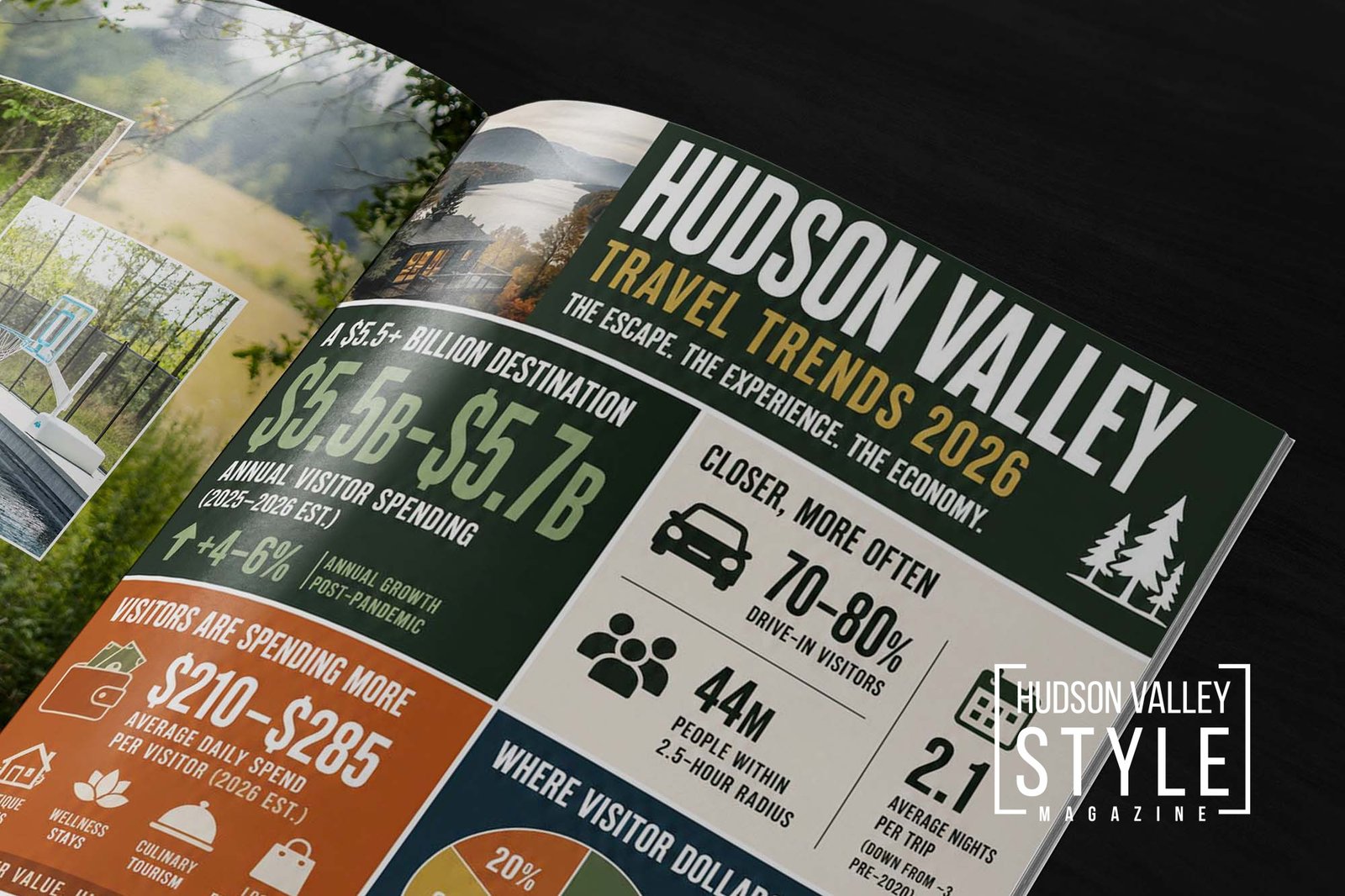
The Hudson Valley continues to establish itself as one of the most economically powerful regional destinations in the Northeast, with visitor spending surpassing $5 billion annually and projected to reach roughly $5.5B–$5.7B in the current cycle. In this infographic we are presenting data points from various local sources. Recent data from Mid-Hudson Valley tourism revenue reports shows the region generating over $4.2B in direct visitor spending, translating to nearly $3,923 per resident—an outsized economic impact driven largely by consistent domestic travel demand. With access to more than 44 million people within driving distance, as noted in regional travel trend analysis, the Hudson Valley has become a repeat-visit destination fueled by proximity and ease.
Hudson Valley Travel Trends 2026: $5.5B Tourism Economy, Visitor Growth & Regional Travel Shift – Luxury Travel – Wellness Travel – Travel – Presented by Alluvion Vacations

Travel behavior has shifted meaningfully in recent years, with visitors opting for shorter, more frequent trips rather than extended vacations. The majority of travelers now arrive by car, reinforcing the region’s role as a weekend-driven escape. At the same time, spending patterns are trending upward, with daily visitor expenditures estimated between $210 and $285, driven by demand for food, nature, and curated local experiences. According to Hudson Valley tourism insights, dining alone accounts for a significant share of visitor spending, with more than half of restaurant revenue in some areas tied directly to tourism activity.
Short-term rentals have evolved into one of the most dynamic and high-performing segments of the Hudson Valley travel economy, complementing traditional hotels while reshaping how visitors experience the region. Industry data from platforms like AirDNA shows that vacation rentals now represent roughly 30–45% of available lodging inventory in high-demand Hudson Valley markets, with especially strong presence in design-forward and nature-driven destinations. This growth reflects a clear shift in traveler preference toward privacy, space, and curated environments, where the stay itself becomes part of the experience rather than just accommodation. At the same time, hotels continue to play an important role in overall capacity, particularly for events and larger-scale travel, creating a balanced ecosystem. The broader rise of short-term rentals as a premium travel category highlights how elevated design, unique properties, and lifestyle-driven stays are driving higher occupancy rates and increased nightly values across destination markets like the Hudson Valley.
At the county level, the impact becomes even more tangible. Dutchess County tourism data reports over $800 million in annual visitor spending, reflecting steady year-over-year growth and reinforcing the importance of tourism to local economies. Across the region, small towns, farms, and independent businesses continue to benefit from this influx, as the Hudson Valley evolves beyond a seasonal destination into a year-round ecosystem built on food, landscape, culture, and experience.