
Forsythia arrives before anything else has the courage to. It floods entire hillsides in gold while the rest of the natural world is still deliberating, staking its claim on the season with the ease of something that has survived enough winters to stop apologizing for taking up space. Against this backdrop, one of the most compelling fashion stories of spring 2026 unfolded in the Hudson Valley: a Filipino designer’s orchid-inspired gown, a Filipina-American healer, and a meadow that had absolutely no interest in being subtle.
The Language of Bloom: Spring 2026 Fashion, Indigenous Beauty, and the Rise of the Hudson Valley – by Maxwell Alexander, MA(FIT)/BFA(SVA), EIC, Hudson Valley Style Magazine | Photography by Maxwell Alexander

Spring 2026 and the Fashion Season That Changed the Conversation
The defining current of spring 2026 fashion moves beneath the trend cycle entirely. After years of aesthetic noise — algorithmically accelerated microtrends, fast fashion’s relentless churn, the hollowing out of craft in favor of content — something quieter and considerably more powerful is asserting itself on the global stage. Indigenous motifs are arriving not as borrowed decoration but as living cultural inheritance. Botanical references are grounding collections in ecological reality rather than escapist fantasy.

Designers with deep roots in non-Western traditions are bringing ancestral knowledge onto runways and into editorial spaces with an authority that signals not a trend but a correction. Spring 2026 is the season fashion started telling the truth about where beauty actually comes from — and who has been its most faithful guardian all along.

Ehrran Montoya and the Craft of Cultural Memory
As someone who studied experiential design and storytelling at FIT and has spent years as an art activist at the intersection of human rights, identity, beauty, sexuality, and environmental justice, I have learned to read clothing the way ecologists read soil — as a record of what came before, what survived, and what is quietly insisting on a future.

When I first encountered Ehrran Montoya’s work, I recognized immediately the sensibility of an artist operating at that same frequency: someone who understands that beauty is inseparable from survival, that craft is inseparable from resistance, and that the most radical thing a designer can do in this moment is reach into ancestral memory and bring something forward that the colonial project assumed it had buried.

Ehrran Montoya is a Filipino fashion-artist from Morong, Rizal — Fine Arts graduate, former Creative Director under the celebrated Francis Libiran, and one of the most resonant voices in contemporary couture to emerge from Southeast Asia. His collections draw from nature as cultural language: the Lepidoptera series explored transformation through butterfly morphology, the Chrysalis collection was built through indigenous textiles with silver fibers, and his Secrets of Awakening series was described by Montoya himself as a divine calling expressed through fabric, silhouette, and sacred beauty.

His touchstones — Alexander McQueen, Rei Kawakubo, Jean-Paul Gaultier — are designers who understood that clothing is never merely clothing. It is argument. It is memory. It is politics rendered in textile form. What moves me most about Ehrran’s practice specifically is that his politics are inseparable from his botany — he draws from endangered flora, from sacred indigenous relationships with the natural world, from the understanding that when we lose a species we lose a story, and when we lose a story we lose something that extraction can never restore.

His work has reached the global stage in the most visible way possible. Ehrran Montoya has dressed Miss Universe Philippines contestants and major Filipino celebrity muses, bringing indigenous Philippine motifs onto international platforms where they belong — not as exotic reference points for Western consumption, but as sovereign aesthetic traditions speaking in their own voice to the world.

When indigenous design reaches the Miss Universe stage, when it appears in international editorial, when it is worn by healers in Hudson Valley meadows photographed against spring bloom, it is completing a journey that colonialism interrupted and never managed to end.

The Gown: Waling-Waling in the Hudson Valley
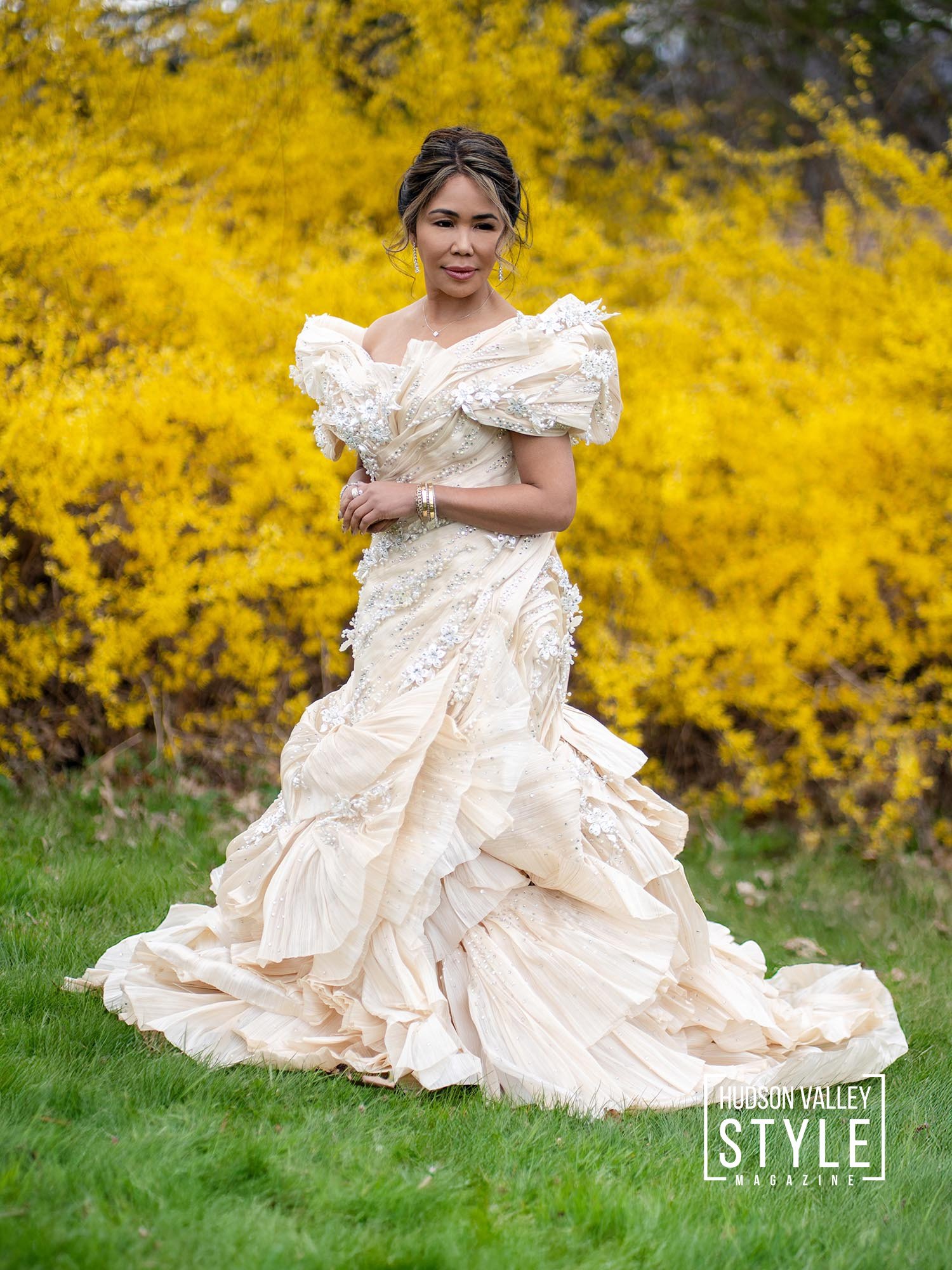
The gown worn in these photographs carries its cultural argument all the way down to the fiber. Ehrran Montoya constructed this piece from abacá — known internationally as Manila Hemp — a plant native to the Philippine archipelago, harvested from the leaf stalks of a wild banana species that has been cultivated by Filipino communities for centuries. Abacá is one of the strongest natural fibers in the world, used historically for rope, textiles, and sacred weaving traditions long before colonial trade routes commodified it.

To build a couture gown from abacá is to bring the earth itself into the construction — to insist that the material of the garment carries the same cultural memory as its silhouette and embroidery. In a global fashion moment increasingly defined by the return to natural and sustainable materials, this choice places Montoya at the leading edge of a movement that is reshaping how the industry understands luxury. Sustainability in spring 2026 fashion is no longer a compromise or a marketing addendum. It is the creative premise.

The silhouette itself carries a second layer of cultural conversation. The dramatically ruffled off-shoulder construction is a contemporary reimagining of the Filipiniana — the traditional Philippine formal dress defined by its iconic oversized butterfly sleeves, a garment that has represented Filipino national identity and feminine elegance for generations. Montoya’s version distills that heritage into something fluid and modern, the sleeves softened into cascading ruffles that move like water rather than standing at architectural attention, while retaining the essential spirit of the original: a garment that announces presence, that commands a room, that was always about the dignity of the woman wearing it rather than the occasion requiring it. This is the wink embedded in the construction — a knowing conversation between contemporary couture and ancestral form that only reveals itself fully to those fluent in both languages.

Layered over the abacá foundation, hand-embroidered three-dimensional floral appliqués and pearl beadwork scattered like filtered forest light draw from the waling-waling orchid, the queen of Philippine flora, sacred to the indigenous Bagobo people of Mindanao. The waling-waling grows only at altitude in old-growth conditions, on a timeline entirely its own, answering to nothing cultivated or commercial. It is among the most endangered orchids in the world — a flower whose survival is inseparable from the survival of the ecosystems that extractive industry has spent centuries dismantling. To wear it is to carry a statement about what we stand to lose and what we are choosing to protect. The headpiece — a sculptural spiral of white leaves rising upward like a crown that chose itself — completes a silhouette that arrived on its own authority, rooted in the earth it grew from.

To photograph this gown against Hudson Valley forsythia was to witness two botanical traditions in genuine dialogue: Philippine tropical and Northeast American spring, both rooted in indigenous relationships with land that predate every empire that has since claimed ownership of either landscape. The gold of the forsythia and the champagne of the abacá found each other the way authentic things always do — without negotiation, without effort, as though the composition had been waiting for both of them to arrive.

Bridal Fashion Reimagined: The Gown Beyond the Wedding
The spring 2026 bridal fashion conversation is expanding well beyond the ceremony. Wedding gowns and bridal-inspired couture are increasingly being commissioned as standalone works of wearable art — pieces that celebrate the woman herself rather than marking a transition between social contracts. This cultural shift is one of the most significant movements in contemporary fashion: the understanding that a magnificent gown is an artwork, and that artworks belong to whoever has the vision and the courage to wear them.

Ehrran Montoya has been at the leading edge of this movement throughout his career, designing bridal collections — Secret Garden, Secrets of Awakening — that he explicitly frames around archetypes of female sovereignty rather than conventional wedding narratives. His brides are the Immaculate Bride, the Unapologetic Bride, the Rebirth Bride — states of being rather than steps in a ceremony.

The spring 2026 woman commissioning a gown like this one is making an aesthetic and philosophical statement simultaneously. She is investing in craft that carries cultural memory. She is choosing beauty that means something. She is wearing a waling-waling orchid in a Hudson Valley meadow because she decided to, and that decision is the entire point. For those inspired by the intersection of bridal fashion, indigenous design, and contemporary couture that Ehrran Montoya represents, his atelier accepts commissions worldwide — bespoke gowns and suits built to the specific vision and sovereignty of the person wearing them.

Dr. Elaine Suderio: Healer, Builder, Architect of a Different Future
It is one of the quiet honors of my work as a photographer and storyteller to occasionally meet someone whose life is itself an act of cultural subversion so complete that the camera simply has to show up and pay attention. Dr. Elaine Suderio is one of those people. She is Co-Founder and Medical Director of Vivash Medical Spa, with locations in Mahopac and Beacon, New York, and Co-Founder of Hudson Valley Ketamine Lounge, where she works at the frontier of mental health care that prioritizes genuine healing over managed dependency. She holds the Doctor of Nursing Practice — the highest clinical degree in her field. She is an assistant professor of nursing at Mount Saint Mary College, a clinical trainer for InMode and Prollenium, and she paints — because her artistic sensibility and her clinical precision are the same capacity expressed in different rooms.

Her philosophy at Vivash moves on five words: look good, feel good, do good. Confidence restored is dignity returned. When someone looks in the mirror and recognizes themselves, they grow more capable of everything else — of resistance, of imagination, of full participation in their own lives. Vivash makes aesthetic medicine genuinely accessible to Hudson Valley residents: Botox and dermal fillers as tools of restored confidence, Morpheus8 radiofrequency treatments for skin renewal, PRP hair restoration, IV vitamin therapy, and at the clinical frontier, ketamine infusion therapy for depression, PTSD, and chronic pain — treatments reaching people where conventional pharmaceutical approaches have fallen short.

Through the NYACT training division, Vivash functions as a formal education center for medical professionals across the region, built on the conviction that elevating providers elevates care for everyone. A healthcare philosophy with quietly redistributive consequences, delivered in a space that Hudson Valley residents describe as feeling like home.

What connects Dr. Elaine’s work to Ehrran Montoya’s, and to this shoot, and to the broader cultural argument of spring 2026, is the understanding that healing and beauty are political acts when they are made accessible to everyone rather than reserved for the few. The sick care system was built on the same extractive logic as the fossil fuel economy — profit maximized, dependency maintained, the actual restoration of human dignity kept just out of reach. Dr. Elaine builds in the opposite direction. Every person who walks out of Vivash feeling more fully themselves is a small act of liberation from that system. Every gown Ehrran Montoya builds from indigenous botanical memory is a small act of cultural repatriation. These are not separate projects. They are the same project, expressed in different materials.

From the Collapsing Shore to Higher Ground
Earlier this spring I was in Montauk, photographing what remains of the dunes at Hither Hills — the collapsed crosswalks, the eroding shoreline, the uninsurable beach houses whose foundations the Atlantic has already quietly decided to reclaim. That story, The Last Beach, was about endings — about the aesthetic and moral destination of a culture built on extraction and the systematic avoidance of consequence.

This story is its sequel, and it takes place hundreds of feet above sea level in every sense. The defining fashion and cultural trend of spring 2026 is the movement from that shoreline to this meadow — from the spectacle of collapse to the quiet authority of what has been building on higher ground all along. Solidarity. Authenticity. Indigenous wisdom flowering through the wreckage of empires that assumed permanence. Beauty as a form of justice rather than a reward for compliance.

The Hudson Valley and the Future Already in Bloom
Healers, artists, educators, and people carrying ancestral knowledge the colonial project attempted to suppress are building something real in the Hudson Valley — institutions that serve communities rather than extract from them, that make beauty and healing and culture accessible rather than exclusive. It takes a village to reverse climate change. It takes a village to dismantle the patriarchy. It takes a village to restore the dignity that extractive systems have spent centuries systematically removing from the people they depended on to function. The Hudson Valley is becoming that village — not because it was designated as such by any authority, but because the people doing the work decided to be here and started building.

What Ehrran Montoya contributes to this conversation is the reminder that the indigenous cultures this empire built itself on top of went underground rather than away. They held at altitude. They waited in old-growth conditions on their own timeline. The waling-waling orchid blooms when it is ready, in the conditions it requires, answering to nothing that extraction has to offer. So does justice. So does the kind of beauty that carries genuine cultural memory in its structure rather than borrowing someone else’s heritage for a season and moving on.

Standing in a Hudson Valley meadow with a camera, watching Dr. Elaine Suderio move through a field of forsythia gold in an Ehrran Montoya gown built from the sacred flora of her ancestral homeland, I was reminded of why I believe — without irony, without qualification — that beauty will save the world.

A Filipino artist’s orchid gown in spring 2026, worn by a healer who asked nobody’s permission to be magnificent, photographed against forsythia that also asked nobody’s permission — this is a dispatch from the world already replacing the one losing its foundations to the sea. The bloom is here. The season has begun.

With Gratitude
This story came to life through the talent and generosity of extraordinary people. Hair and styling by Chelsea Clark at Spalon Day Spa in Hudson, New York — whose artistry completed the visual language of this shoot with quiet precision. The gown by Ehrran Montoya, whose hands and vision brought centuries of Philippine cultural memory into a Hudson Valley spring morning. And Dr. Elaine Suderio — healer, builder, and one of the most compelling human beings this lens has had the privilege of meeting — whose work at Vivash Medical Spa continues to redefine what accessible beauty and healthcare can mean for this community and beyond.
This photoshoot was made possible through the vision and support of Dino Alexander at Alluvion Media — a collaborator whose belief in the power of authentic visual storytelling makes work like this possible. Grateful to the full team at Hudson Valley Style Magazine and Alluvion Media for building a platform where these stories find their home.