
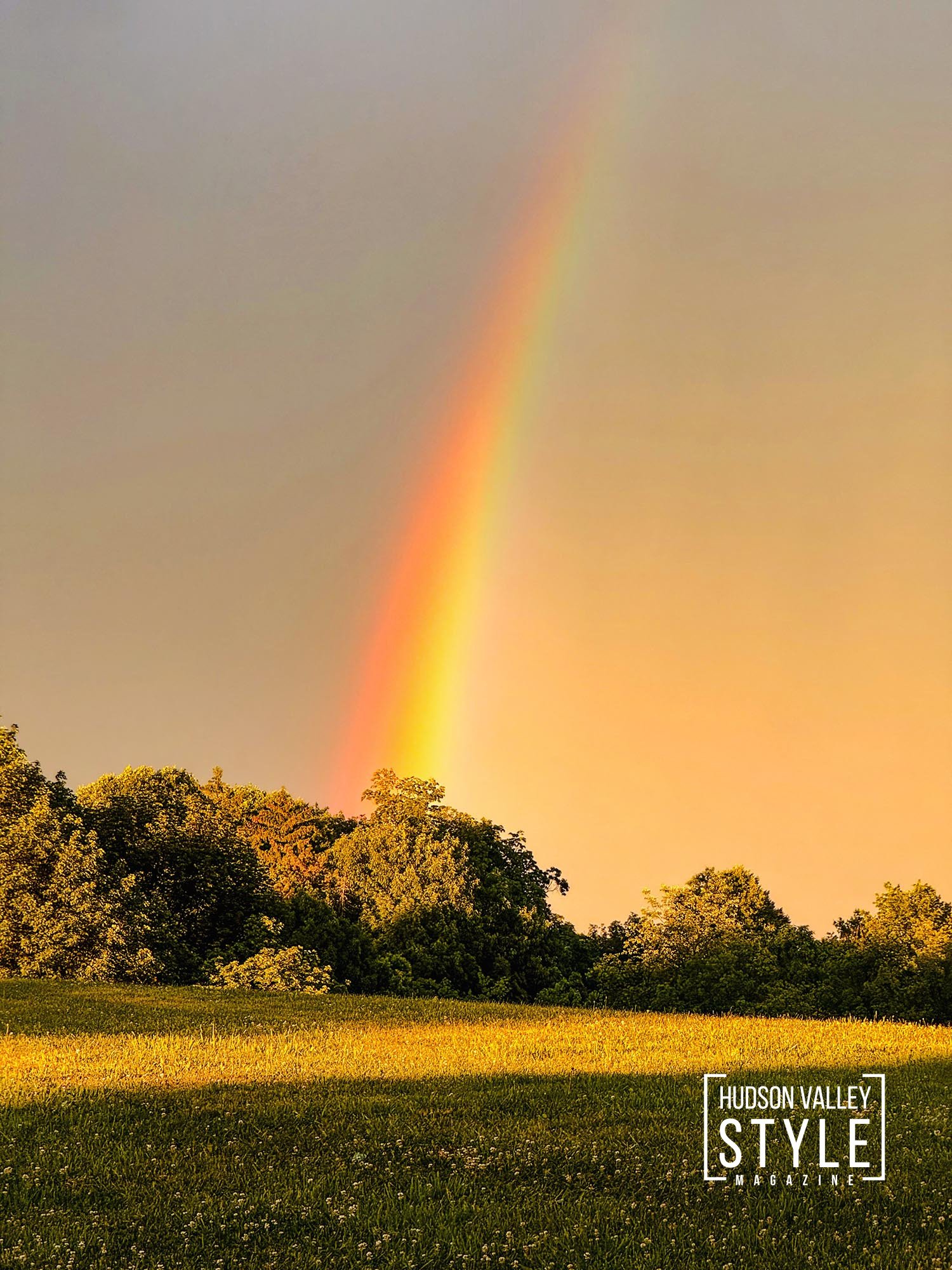
The storm had already moved on by the time the rainbow appeared above the Hudson Valley. Sunlight broke through the western clouds and stretched across the landscape — fields, peaceful meadows, the tree line dissolving into afternoon haze — and for a few brief minutes the atmosphere transformed itself into a prism, revealing a spectrum that had been present all along. A prism filter on the lens fractured the light further, a reminder that perception is always partly a matter of the instrument you choose to look through. Most people looked up and saw color. I looked up and saw a question.
The Rainbow Was Never the Story: Gender Fluidity, Modern Masculinity, and the Human Search for Identity in the Hudson Valley — Essay and Photography by Maxwell Alexander, MA Experiential Design (FIT) | BFA Graphic Design and Branding (SVA) | Artist, Activist, and Independent Scholar | Homoerotic Fine Art Photographer | Certified Fitness Trainer, Bodybuilding and Sports Nutrition Coach | NYS Licensed Real Estate Education Instructor | Entrepreneur

Why does humanity remain so deeply attached to permanence in a world where nothing stays the same?
The question extended far beyond the rainbow. It reached into history, politics, religion, economics, gender, identity, and every institution that has ever attempted to organize human life according to fixed categories. Standing beneath that arc of color, I found myself thinking less about the sky and more about the strange civilizational habit of mistaking temporary arrangements for eternal truths — and the remarkable amount of bureaucratic energy devoted to maintaining that confusion.

The Hudson River and the Arrogance of Certainty
The Hudson River has spent thousands of years watching human beings arrive with absolute confidence in their understanding of reality. Empires have appeared along its shores convinced of their permanence. Religions have declared exclusive possession of ultimate truth. Governments have passed laws designed to transform cultural assumptions into social facts. Each generation inherits these structures and typically treats them as natural features of the world rather than historical inventions — which is, of course, exactly what those structures prefer.

Michel Foucault spent his career mapping this process. His archaeology of knowledge traced how societies produce systems of discourse that determine what counts as truth, whose knowledge matters, and which forms of human experience are legible to institutions at all. Power, in Foucault’s analysis, does not merely prohibit — it produces. It produces categories, subjects, norms, and the very sense of what it means to be a self. The river, indifferent to all of this, offers a useful corrective. Water flowing through the Mahicantuck today bears no physical relationship to the water that occupied the same channel a century ago. The river remains recognizable precisely because it changes continuously. Its identity emerges through movement rather than stasis. Human institutions rarely demonstrate the same humility, which may explain why so many of them eventually get wet.

The Spectrum Hidden Inside the Light
The rainbow quietly dismantles the assumption that diversity requires explanation while conformity represents the natural condition of things. Every color visible in the sky after a storm already existed within the sunlight before the first raindrop fell. The atmosphere did not manufacture diversity. It revealed diversity.

Judith Butler‘s theory of gender performativity operates on a structurally identical logic. In Gender Trouble (1990), Butler argued that gender is not an expression of some inner biological essence but a citational practice — a repeated performance of norms that retroactively produces the illusion of an original, stable identity. The binary appears natural because it is performed so consistently and enforced so systematically that the performance gets mistaken for the thing itself. What the rainbow suggests, and what Butler’s work confirms, is that the spectrum was always there. The social conditions for seeing it are what change. Every forest contains countless forms of life participating in relationships too complex for any single observer to fully understand — a point that applies equally to meadows, mycorrhizal networks, and gender.

The Civilization of Categories
Much of human history can be understood as a long project of classification. Civilizations categorize land, labor, wealth, race, class, citizenship, sexuality, morality, and gender. These categories help institutions function — governments require definitions, legal systems require boundaries, bureaucracies require boxes — and the administrative state depends upon its ability to sort people into manageable groups. Problems emerge, reliably and repeatedly, when administrative convenience gets confused with reality itself.

Sylvia Wynter traces this confusion to what she calls the overrepresentation of Man — the process by which a specific, historically particular model of the human (Western, bourgeois, colonial, heterosexual) came to stand in for humanity as such. For Wynter, the liberation project is not simply one of inclusion into existing categories but the far more radical work of reimagining the genre of the human altogether. The gender binary is not a mistake to be corrected within the existing framework. It is a symptom of a deeper epistemic structure that must be rethought from the ground up. The rainbow contains no such conflict. Every color participates in the whole without surrendering its particularity. Difference does not threaten the spectrum. Difference creates it.

The Self as an Ecosystem
One of the stranger expectations imposed by contemporary society is the demand for a singular, legible, consistent identity. People are encouraged to discover who they are, define themselves clearly, and hold that definition steady across time — a requirement that sounds reasonable until you start paying attention to actual human experience, at which point it begins to resemble a form of administrative fantasy.

Donna Haraway‘s work offers a more honest account. Her concept of situated knowledge challenges the idea that any subject occupies a stable, unified position from which truth can be objectively perceived. Knowledge, for Haraway, is always partial, always embodied, always produced from somewhere specific — and that specificity is not a limitation to be overcome but the very condition of genuine understanding. Karen Barad extends this further through what she calls agential realism: the self is not a pre-given entity that subsequently enters into relationships, but an ongoing phenomenon that emerges through material-discursive intra-actions. Identity, in other words, is not something you have. It is something that happens — continuously, contingently, in relation.

The self behaves less like a monument and more like an ecosystem. Different dimensions emerge under different conditions. Creativity appears in one environment, strength in another, vulnerability and desire, ambition, and curiosity moving through the individual according to circumstance. Much of my own photographic work has become an exploration of exactly this. In Dew & Desire: A Morning in the Catskills, the human body dissolves into the landscape, suggesting that identity may be less about separation and more about participation in larger ecological processes. In Return to Form: Real Men, Naked Yoga, and the Queer Wilderness of the Catskills, masculinity emerges not as performance or domination but as presence, embodiment, and connection. In Cocky Cowboy and the Wild East, Americana itself becomes a site of contestation where queer desire enters a cultural mythology that previously had a very strict guest list.
These projects may appear visually distinct, yet they investigate the same question: how many versions of the self can exist simultaneously before the concept of a singular identity collapses under its own administrative weight?

Life at the Borderlands
Gloria Anzaldúa understood something that many institutions continue struggling to comprehend: some of the most fertile territory in human experience exists at the border. In Borderlands/La Frontera, she explored the productive tension created when identities, cultures, languages, histories, and ways of being overlap rather than remain neatly separated. The borderland is not a place of confusion — though institutions tend to treat it as one, usually while filing paperwork to have it rezoned. It is a place of creation. New possibilities emerge precisely because old categories begin losing their grip.

Much of my own work inhabits these borderlands by necessity as much as by choice. The photographs refuse to concern themselves with masculinity alone, queerness alone, nature alone, or art alone — a refusal that has proven consistently inconvenient for anyone attempting to file them in an existing drawer. They exist in the space between categories where cultural assumptions become unstable and new forms of meaning can surface. Whether exploring the body as landscape in The Rich Meaning of Naked Freedom and Homoeroticism, examining homoerotic photography as a direct response to cultural exclusion in Capturing the Male Form as a Defiant Stand Against Homophobia in Art and Society, or deploying humor to expose the structural absurdity of gender performance in Thong of the Free, the underlying question holds: who benefits when human beings are forced into categories that cannot accommodate the actual complexity of their lives?

The rainbow above the Hudson Valley occupied a borderland of its own — suspended between storm and sunlight, between visibility and erasure, between the permanent and the passing. Like the identities this essay refuses to simplify, it emerged through relationship rather than isolation. Its coherence came not from purity but from coexistence. Every color held its distinctness while participating in something larger — which is, it turns out, a more sophisticated organizational principle than most institutions have managed to implement.

What Indigenous Knowledge Never Needed to Prove
Long before contemporary theorists began questioning rigid categories of identity, many Indigenous cultures understood existence through relationships rather than classifications — a fact that Western academia has spent considerable energy rediscovering and crediting primarily to Western academics.
Vine Deloria Jr., in Red Earth, White Lies and throughout his work, argued that Western science’s insistence on universal, context-free truth systematically excluded Indigenous epistemologies that understood knowledge as relational, place-based, and accountable to living communities rather than abstract institutions. The Lenape, whose ancestral homelands include much of the Hudson Valley, inhabited a landscape shaped by reciprocal relationships among land, water, animals, seasons, and community. One worldview asks how human beings belong. The other asks what human beings can possess. The distinction is not merely philosophical. It determines what gets built, what gets destroyed, and whose experience gets counted as knowledge worth preserving.
The rainbow appeared to side with relationship.

The Fear Beneath Fixed Identities
Many social conflicts surrounding gender, sexuality, and identity ultimately disclose a deeper anxiety about change itself. Fluidity challenges certainty. Ambiguity challenges authority. Transformation challenges systems that derive their legitimacy from the appearance of permanence.

José Esteban Muñoz, in Cruising Utopia (2009), proposed queerness not as an identity category but as a horizon — a mode of futurity oriented toward what he called the not-yet-here. For Muñoz, queer existence is fundamentally utopian in its rejection of the normative present and its insistence that other ways of being remain possible. This is not naïve optimism. It is a rigorous refusal to accept the present arrangement of things as natural, inevitable, or final. The gatekeeping mechanisms that I examined in My Museum No One Goes To operate precisely to foreclose that horizon — to manage which bodies, desires, and voices are permitted to constitute culture, and which are quietly omitted. Gatekeeping rarely presents itself as censorship. It presents as expertise, quality control, professional standards, and curatorial vision — which is, functionally, a more elegant version of the same operation.

The digital age has begun destabilizing this arrangement in ways that are genuinely irreversible. Artists, writers, photographers, and creators no longer depend entirely on traditional cultural institutions for visibility or legitimacy. The LGBTQ+ communities that once existed largely outside official cultural narratives can now document and publish themselves directly. Institutions that once controlled visibility with minimal accountability are discovering that their authority was always more contingent than it appeared — a realization they are handling with varying degrees of grace.

The Future Already Exists
As the rainbow dissolved into the evening sky, nothing essential vanished. The sunlight still contained the spectrum. The atmosphere still held moisture. The Hudson River still moved through the valley. What changed was visibility — the conditions for seeing what had been there all along.

The growing visibility of LGBTQ+ identities does not indicate the sudden appearance of something new. Human beings have always embodied a broad range of identities, desires, and ways of moving through the world. What changes across history is the degree to which societies permit those realities to become legible — and the degree to which institutions succeed in managing, deferring, or extinguishing them. As I explored in The Last Beach: A Montauk Pilgrimage Before the Ocean Takes It Back, nature does not negotiate with political ideologies. Rising seas do not recognize property lines. The ocean has no opinion about what the current administration prefers. Reality eventually reasserts itself regardless of the confidence with which human systems have declared themselves permanent.

What feels genuinely different about the present moment is the convergence. Climate change is making ecological accountability impossible to defer. Artificial intelligence is disrupting traditional gatekeepers of knowledge. Digital publishing has fractured the cultural monopoly on legitimacy. Across domains, realities that were once hidden behind institutional authority are becoming increasingly difficult to ignore. The future Muñoz envisioned as horizon is pressing against the present with unusual insistence.

Perhaps the task is not to invent new forms of freedom. Perhaps it is to learn to recognize what has always been there — like the colors hidden inside sunlight, waiting for the conditions that make them visible. The rainbow above the Hudson Valley lasted only a few minutes. It did not need to last longer to make the point.
Works Cited & Further Reading
- Barad, Karen. Meeting the Universe Halfway: Quantum Physics and the Entanglement of Matter and Meaning. Duke University Press, 2007.
- Butler, Judith. Gender Trouble: Feminism and the Subversion of Identity. Routledge, 1990.
- Deloria, Vine Jr. Red Earth, White Lies: Native Americans and the Myth of Scientific Fact. Fulcrum Publishing, 1997.
- Foucault, Michel. The Archaeology of Knowledge. Pantheon Books, 1972.
- Foucault, Michel. Discipline and Punish: The Birth of the Prison. Pantheon Books, 1977.
- Haraway, Donna. “Situated Knowledges: The Science Question in Feminism and the Privilege of Partial Perspective.” Feminist Studies 14, no. 3 (1988): 575–599.
- Muñoz, José Esteban. Cruising Utopia: The Then and There of Queer Futurity. New York University Press, 2009.
- Wynter, Sylvia. “Unsettling the Coloniality of Being/Power/Truth/Freedom: Towards the Human, After Man, Its Overrepresentation — An Argument.” CR: The New Centennial Review 3, no. 3 (2003): 257–337.
- Anzaldúa, Gloria. Borderlands/La Frontera: The New Mestiza. Aunt Lute Books, 1987.