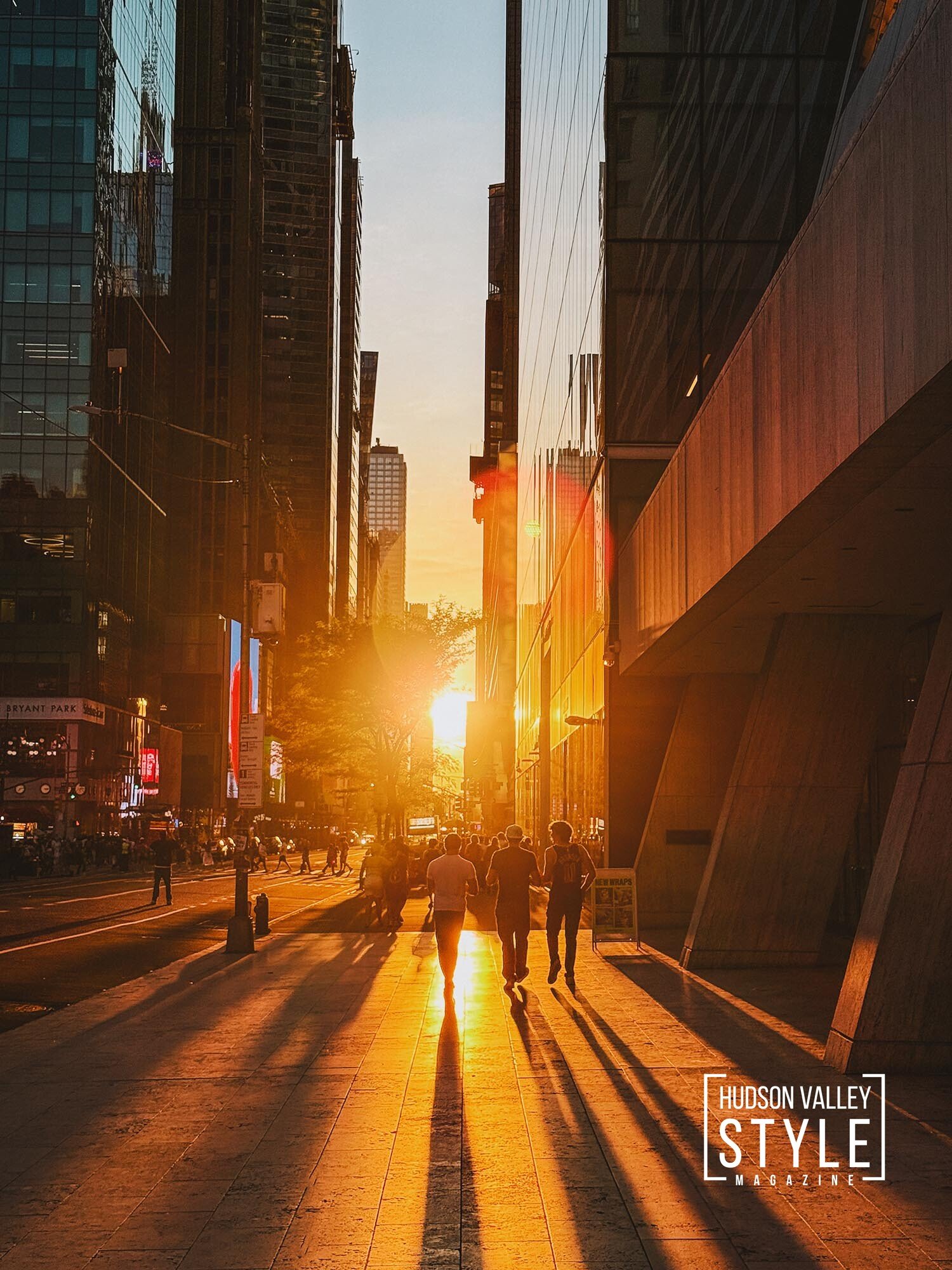
Eight minutes a year, Manhattan becomes a cathedral built entirely by light.
The grid was drawn by men counting property lines, not sunsets. And yet twice a year the sun drops directly into that grid and Forty-Second Street becomes something closer to Stonehenge than to a bus route — which is precisely why Manhattanhenge works on me the way it does: it is proof that beauty finds its way through even the most transactional architecture, whether or not anyone planned for it to.
Manhattanhenge and the Architecture of Awe – By Maxwell Alexander, MA(FIT), BFA(SVA), Artist/Photographer, Fitness Trainer, Bodybuilding and Wellness Coach | Emotional Wellness & Identity Series | Photography & Philosophy by Maxwell Alexander
This is a photo story built the same way that light finds its way down a canyon of glass — sideways, unannounced, gathering everything it touches into one thread. The river towns and the skyscrapers, the wildflowers and the male body, the skyline I edited myself into years before I ever stood there in real life — none of it was designed to cohere into a philosophy. It cohered anyway.

The Canyon Opens
Office workers stopped mid-stride. A woman in the crosswalk turned around instead of finishing her crossing. The street went copper, then gold, then something without a name, and for a few minutes the most aggressively commercial avenue in the country simply stopped being about getting anywhere. Nobody organized this. The buildings leaned in like they were listening, and the crowd below them did the same. There is a kind of activism in that — a body, a street, an entire city choosing stillness over throughput, without permission from anyone.

Water Under Everything
The Hudson does not need eight minutes of planetary alignment to earn attention. It has been carving this valley since long before Midtown had a name, and it will keep doing so after the glass has gone to rust. Watching the sun drop into the marina at Newburgh, the light behaves the way New York’s does not — it slows, it bleeds into water instead of ricocheting off it — and the river remembers what the Lenape and Mohican understood before anyone laid a grid across their land: that a river is a relative, not a resource. That reciprocity, not extraction, is the older and better operating system. This is the same water documented in the river that built New York, still making the same argument in every direction it flows.

Sky as Permission Slip
Pink cumulus catching last light. Sun breaking gold through a canopy so dense it looks hand-forged. A second sunset filtered through summer leaves. None of it required an audience — it happened whether or not a single person in the Hudson Valley bothered to look up. Choosing stillness is simply choosing to be one of the people who did. The algorithm was never going to serve you this one; you had to close the app and step outside for it yourself.

The Universe, Magnified
A stalk of wheat backlit by a dying sun. A blackberry cluster ripening through every stage of its own becoming at once — green, coral, garnet, ink, all on the same branch, in the same frame, refusing to pick a single moment to be. A daisy so precisely radial it looks engineered, though nothing engineered it except several hundred million years of sunlight negotiating with a seed.

The same spiral logic governs a flower head, a hurricane, and a galaxy, and I went looking for that logic more directly while sculpting the cosmos in three dimensions. A dew-beaded petal and an erect phallus are kin. So, it turns out, is a wheat husk and a spiral nebula. The universe keeps repeating its favorite ideas at every scale it can reach. Attention is simply the practice of noticing.

Steel, Reconsidered
Look straight up in this city and the buildings stop being real estate and start behaving like cathedrals with a different god. Glass towers lean toward each other over Bryant Park as if sharing something private. A canyon on the East Side turns molten at golden hour, every window its own small sun. Men built this skyline without calling themselves artists. The masculinity worth keeping is the kind still capable of being stopped cold by its own creation.

The Brooklyn Bridge, Twice
I photoshopped myself in front of this bridge as a previous version of myself — beautifully, because I was an artist even then — in software that crashed more than it rendered, the real skyline still feeling like something that happened to other people. Now I photograph the actual arches from a boat on the East River, cables fanning out like a harp built for giants, the whole structure lit like it knows exactly how good it looks. The counterfeit was never the goal. It was the rehearsal for a home I hadn’t grown into yet. I didn’t dream that far ahead — that the same hands rehearsing a fake skyline would someday hold the real prints bare-skinned, daring the machines to look away.

The Body as the Last Uncensored Archive
Every photograph in this story — the bridge, the river, the wheat, the sky — has already been scraped without consent by the same AI companies now deciding what human creativity is worth. Mine, yours, every artist’s or photographer’s who has ever posted a portfolio anywhere public. So here is a print of my own skyscraper photography, held against my own skin, and that is not a neutral choice. Homoerotic fine art, in the lineage running from Tom of Finland through Mapplethorpe, has always understood the body’s honesty as a form of resistance no tech oligarch can fully license, sanitize, or launder into a training set.

The fine art print itself is available through HARD NEW YORK gallery of my art activism, but the point of the photograph is the contradiction it holds: patriarchal shame built the discomfort around this body. It never built the body. And its grip on both the art and the artist is loosening in real time.

Palm House, Cowboy Hat
Under fan palms grown for people who will never see a desert, inside a greenhouse dome built by men who once believed iron and glass could out-argue climate itself, the Cocky Cowboy shows up uninvited, sunglasses catching the ironwork overhead. He is not a costume. He is the version of masculinity that does not need to dominate a room to be taken seriously in it — only to occupy his own body without flinching. The palms have no idea they’re indoors. He does not care that you know he’s performing. Both are true, and neither cancels the other out.

Rhythm, Not Restlessness
None of this — the bridge, the river towns, the macro work, the skyline, the body — runs on a schedule that respects a calendar. Standing in a closed street watching a sunset align with a grid nobody designed for that purpose, surrounded by strangers who all independently decided this moment deserved their full attention, is the opposite of burnout. It is what happens when rhythm, not hustle, is allowed to recharge a mind. If there’s a practical tip buried in eight minutes of orange light, it’s this: schedule the stillness before the world schedules something else into that slot for you.

Smoke on the Ridge Line
There was a few days last week when the Hudson Valley and New York City sky went the color of an old photograph — a flat, sepia haze sitting over the ridge lines, wildfire smoke drifting down from Canada and settling into every lung in the county whether or not anyone here had asked for it. Air quality alerts replaced weather reports. People canceled hikes, canceled shoots, kept families indoors on days that looked, from a distance, almost beautiful. That contradiction is the whole crisis in miniature: the smoke made for a gorgeous sunset and a genuine public health emergency in the same breath, and both of those things were true at once.

Climate collapse and surveillance capitalism come from the identical impulse, wearing different suits. Both treat the commons — a river, a forest, a person’s attention, a person’s face — as raw material to be extracted, monetized, and left depleted for someone else to manage. The same handful of corporations that spent a decade training algorithms on artists’ work without consent are, not coincidentally, often the same entities lobbying against the regulations that might have kept a livable atmosphere intact. Illicit monopoly and ecological extraction are cousins; they both require a public too exhausted, too distracted, or too disenfranchised to say no.

The Lenape and Mohican understanding of the Hudson as kin rather than as inventory was never quaint. It was a functioning philosophy that predates the entire premise of infinite growth on a finite landscape — the belief that a place belongs first to the people and living things rooted in it, not to whoever can extract the most from it fastest. Holding a nude, uncensored photograph of my own body is a small, deliberate refusal of that same extractive logic: proof that some things — a river, a body, an image — still resist being converted into inventory.

Resistance, at this scale, rarely looks like a barricade. It looks like composting instead of shrugging. It looks like a magazine that keeps its own servers, discloses its own equity stakes, and refuses the ad-tech surveillance stack that most publishers accepted without a second thought. It looks like choosing the farmers’ market over the algorithimically optimized delivery app, the independently owned inn over the extraction-model hotel conglomerate, the local tourism board over the platform that takes thirty percent and gives the region nothing back. None of these gestures alone will cool the planet or break up a monopoly. Together, repeated by enough people who understand that beauty and ethics were never actually separate categories, they are the only version of scale that has ever reliably worked — one household, one river town, one uncensored photograph at a time, refusing to be optimized out of existence.

The Street Closes Itself
By the time the sun dropped fully between the towers, the crosswalk had become something closer to a congregation than a commute. Cameras up, strangers shoulder to shoulder, phones angled toward the same eight minutes of light. Traffic held itself, patient, as if the whole intersection had agreed on something without a single word passing between them. For eight minutes, the most commercial street in America let beauty outrank throughput, and everyone in it, on either side of the badge, chose to stay still and watch the world make its case for itself.

That is the whole philosophy, reduced to one frame: the moment enough people choose awe over hurry, even the systems built to keep us moving will occasionally, briefly, let us stop. New York did not apply to become a cathedral. It simply stood still long enough to let the sun find it — and so, for eight minutes every July, did everyone standing in it.