
The Hat Knows the Way
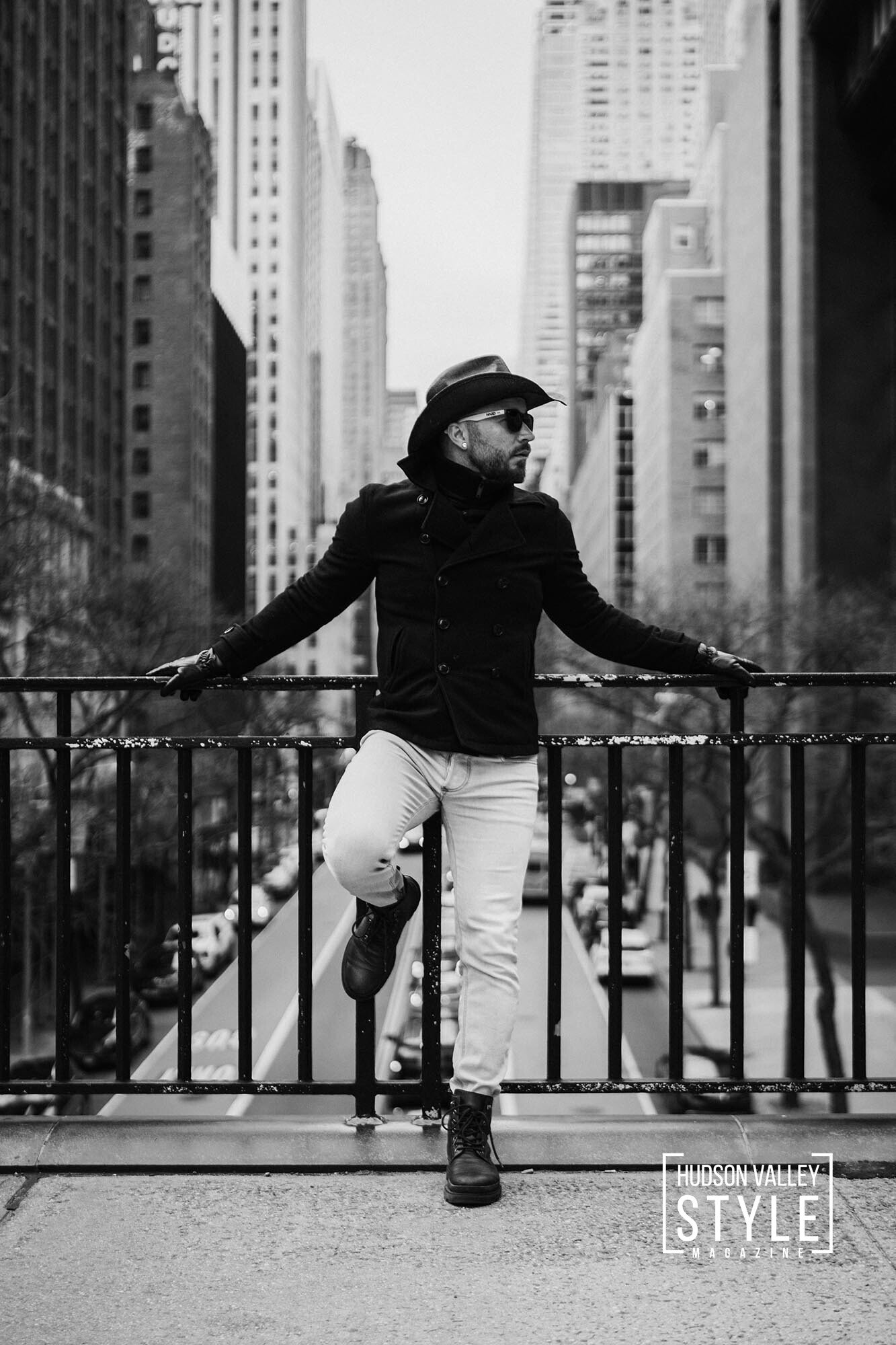
The cowboy hat reaches East 46th Street before any explanation can catch up with it. Its black brim cuts across Midtown’s vertical discipline with the confidence of something that belongs precisely because nobody arranged the meeting. I have worn it so naturally for so many years that the gesture feels closer to handwriting than styling. The coat follows the body closely; pale denim carries the figure into the gray winter light; leather catches a flash from the street and disappears again. New York understands this kind of self-invention because the city has always been full of people who arrived already dressed for the life they intended to inhabit. I feel at home inside that proposition. Give me Manhattan, the Hudson Valley, or Mars—the hat comes with me.
The Cowboy Philosopher: Men’s Fashion, Modern Masculinity and the Art of Being Seen in New York – Men’s Fashion – Men’s Style – Modern Masculinity – Story and Photography by Maxwell Alexander, MA (FIT)/BFA (SVA), EIC, Hudson Valley Style Magazine

New York Taught My Eye to Become Restless
I learned to look here before I understood how demanding looking could become. At SVA, an image could occupy an entire afternoon because composition carried psychology and every visual decision betrayed an intention. Years later at FIT, space acquired another kind of emotional weight: the human figure could change a room simply by entering it, and proportion could make desire visible before language touched it. Those lessons return when I photograph New York in black and white. The city loses its surface noise and becomes structure. A shoulder finds the edge of a tower. The curve of the brim interrupts a façade. Winter light passes over the face and leaves the rest to imagination. Fashion photography becomes thrilling at that exact point, when clothing stops posing for attention and begins altering the way the entire photograph thinks.

The Body Entered the Photograph Slowly
Bodybuilding changed my work almost imperceptibly at first. A jacket began sitting differently across my chest. Photographs started asking more of my posture. The body I saw in the mirror acquired mass and line, and eventually the camera began treating it as form. Training gave me a strange intimacy with proportion because muscle develops through attention measured over years; the eye becomes sensitive to a shoulder sitting a fraction higher, a waist becoming sharper, a leg carrying more volume through denim. When I photograph myself now, I encounter a body that has been deliberately made and remains unfinished in the most beautiful sense of the word. Vanity belongs here too, and I welcome it. An artist who spends his life studying beauty would be terribly dull if he never wished to participate in it.

The Pelvis Has Excellent Timing
The pale denim catches the male body at precisely the point where menswear so often becomes nervous, which makes the photograph considerably more enjoyable. I have been thinking about bulge fashion because the pelvis changes the silhouette in ways fashion criticism rarely examines with the same seriousness granted to a shoulder or a waist. Here anatomy becomes part of the cut. Fabric follows the body and lets desire enter through proportion, posture and movement. My queer eye recognizes that charge immediately and sees no intellectual emergency in it. Beauty can think. Eroticism can possess elegance. A man can invite the gaze and still belong entirely to himself. Museums have survived centuries of magnificent male anatomy carved in marble; I suspect Midtown will recover from my jeans.

Masculinity in the First Person
The cowboy carries an old American romance, yet I encounter him most intimately as an image of self-possession. That quality interests me far more than costume. On my body, the hat belongs beside a cultivated waist, a gloved hand and the unmistakable physicality produced in the gym. Queerness gives the image another current, almost musical in its insistence that masculinity can contain tenderness and erotic vanity while remaining completely assured of itself. I think often about the men we inherit from culture and the man one gradually authors in private. Somewhere between those two figures, style appears. Mine emerged through years of looking at myself, changing myself, photographing myself, and discovering that masculinity becomes far more seductive once it speaks in its own voice.

HARD NEW YORK Is a Legend
HARD NEW YORK enters these photographs like it owns the block. Good. It should. I created the brand with the same instinct that drives much of my work: New York deserves objects with attitude, scale and a sense of humor sharp enough to survive the city. The bags have that presence immediately. Their typography slices through the monochrome frame, while the leather carries enough visual weight to compete with architecture and body alike. I love seeing HARD NEW YORK here because it has moved beyond explanation. Legends acquire that privilege. The name lands in the photograph and brings its mythology with it, leaving the viewer to catch up. A great fashion object should occasionally behave this way. Polite accessories have never interested me very much.

The Man Crossing the Street
New York keeps returning earlier versions of me with astonishing accuracy. I can walk through Midtown now and suddenly feel the young SVA student somewhere inside the same body, still hungry for beauty, still convinced that an image might reveal something life itself had failed to articulate. Age has changed the nature of that hunger. At forty-three, I enter the frame with a deeper affection for the man becoming visible there, because his image carries years that no stylist could manufacture. The photograph holds the evidence in ways I cannot fully explain: in the way I stand, in the ease of the gaze, in the pleasure of being seen exactly as I have chosen to appear. Then the crossing signal changes. I step into the avenue, coat moving behind me, and for one brief second New York gives me the old sensation again—that impossible, tender conviction that beauty might still be enough to save a moment from disappearing.

The Avenue Becomes a Stage
Once the body enters the avenue, New York begins answering it. The width of the street exaggerates the stride; the towers compress distance until a man crossing between two curbs appears suspended inside an architectural canyon. I love that scale because it makes vanity feel almost philosophical. One may spend an hour choosing the exact coat, polishing the boots, adjusting the brim by half an inch, and then step outside beneath buildings designed to make every human ambition look temporary. Fashion responds beautifully to that humiliation. The answer is to walk anyway, shoulders back, coat buttoned, allowing the ridiculous seriousness of personal style to meet the ridiculous seriousness of Manhattan. Somewhere between those two vanities, the photograph becomes alive.

Leather Against Winter Light
The gloves matter because touch matters. Black leather gives the hands a sharper presence, turning an ordinary gesture toward the sunglasses or the brim of the hat into something almost ceremonial. Against wool, stone and pale denim, the leather catches light in brief flashes that guide the eye toward movement. I have always been drawn to materials that reveal themselves through use: the crease at the knuckle, the pressure of a hand around a bag strap, the slight polish that comes from living inside an object. Fashion becomes intimate at that scale. A photograph may show an entire city behind the subject, yet one gloved hand resting against the body can become the place where the eye stays longest. Desire has always understood close-ups better than theory.

The Face Behind the Glass
Sunglasses create a delicious problem for portraiture because they return part of the gaze to the viewer. The eyes disappear, and suddenly the mouth, beard, jaw and tilt of the head begin carrying the emotional weight of the image. I enjoy that withholding. A photograph becomes more seductive when the viewer has to work for intimacy, and New York has trained generations of us in the eroticism of pretending not to look. When the glasses finally come away in several frames, the atmosphere changes immediately. The face becomes accessible, but the mystery survives because access and knowledge are different things. Perhaps that tension explains why portraiture still fascinates me after years behind the camera: a face can reveal itself completely and remain unknowable.

The Body Against Stone
The photographs beside the massive stone wall feel almost private after Midtown. Granite replaces glass, the city recedes, and the body comes forward with greater insistence. The rough surface exaggerates every polished detail of the clothes and makes the pale denim almost luminous. I lean into the wall, lift a boot against it, let the shoulders settle into the coat, and the pose begins to carry the languor of classical portraiture with a distinctly contemporary appetite. The male figure has always looked magnificent against stone; museums have been exploiting that chemistry for millennia. I simply brought better boots. What interests me most is the balance between physical strength and ease. The body has been trained intensely, yet the photograph succeeds when that effort disappears and pleasure takes its place.

What the Camera Keeps
Long after the clothes return to the closet and the afternoon disappears into memory, the photograph keeps a version of the man who stood there. That knowledge gives self-portraiture a tenderness I understood differently when I was younger. The camera records the body at one instant in its long negotiation with time, but it also catches something less measurable: the pleasure of inhabiting oneself. I recognize that pleasure in these photographs. It appears in the stride across the avenue, in the hand resting on the railing, in the slight arrogance of the hat, in the moment before the sunglasses leave the face. Years from now, I may look at these images and remember the weather or the street, but I suspect I will remember something more important first. I will remember how it felt to be this man in New York, and how completely, for the length of a shutter click, I enjoyed being him.

Tudor City and the Erotics of Stone
Tudor City changes the temperature of the story. Midtown’s glass and traffic give way to old masonry, iron railings, steep stairs and those strange elevated views where Manhattan suddenly feels theatrical, almost European in its compression. Against that stone, the body becomes more intimate. The coat darkens into the wall, pale denim lifts the legs forward, and the cowboy hat begins to feel less like an emblem than a private signature. I love how Tudor City permits a photograph to hold grandeur and secrecy at once. The city remains close enough to hear, yet the frame feels briefly removed from its velocity. That pause changes the pose. The body leans, waits, looks away, occupies the architecture with a kind of private confidence. Even the stone seems to understand that seduction works better when it leaves something unfinished.

The Homoerotic Charge
Homoeroticism in these photographs lives in suggestion, proximity and the pleasure of looking. It arrives through the fitted waist of the coat, the tension of denim across the thighs, the gloved hand near the mouth, the exposed line of the neck beneath the hat. None of it needs theatrical emphasis because queer desire has always been fluent in nuance. A glance held too long, a body turned three degrees toward the light, the knowledge that another man might understand the image differently from everyone else — that is enough to change the emotional register of the photograph. I am drawn to this subtler language because it lets masculinity remain expansive. Strength can coexist with sensuality. Reserve can carry erotic heat. A photograph can seduce through posture alone, and the most compelling images often let desire enter sideways.

Bulge Fashion and the Return of the Male Silhouette
Bulge fashion belongs to a wider cultural return of the male body as an object of style, desire and visual authorship. Fitted trousers, athletic tailoring and body-conscious menswear have brought the pelvis back into fashion’s field of vision, where proportion begins to matter from shoulder to ankle. In my own work, that shift feels inseparable from modern masculinity because the male silhouette becomes more complete when the body beneath the clothes remains visible. The effect in these photographs comes from confidence, fit and movement; the eroticism stays embedded in the image instead of performing for attention. I find that far more powerful. Contemporary culture is still learning how to look at men with the same visual intelligence historically granted to women, and queer fashion has been pushing that conversation forward for decades. A well-dressed man can carry elegance, sex and intellectual presence in the same frame. The skinny jeans simply make the argument harder to ignore.
Back to streets now. I’ll see you there somewhere.
– Maxwell Alexander