
A mindful hike through the Hudson Valley begins with one wonderfully simple proposition: pay attention. Let the trail decide what deserves your gaze. Let sunlight interrupt the mental chatter. Let scent become memory. Let a mushroom become interesting enough to earn five whole minutes of your life. Research around forest bathing continues to connect time in green spaces with reduced stress and improved emotional well-being, but the body tends to understand the assignment long before science finishes writing the abstract. My ongoing visual exploration of the region began on a grander scale in Following the Hudson River Into the Soul of a New America; here, the camera moves closer to the forest floor, toward fungi, clover, wildflowers, bark, fragrance, movement and the tiny ecological dramas happening everywhere beneath our usual field of vision.
The Forest Has Been Waiting for You: A Hudson Valley Nature Photo Story About Mindfulness, Wildflowers and the Pleasure of Paying Attention – Photo Essay by Maxwell Alexander, Artist, Photographer, Visual Philosopher – Nature Photography – Emotional Wellness

A Flower Rises Through the Forest Like It Knows Exactly How Fabulous It Is
Bottlebrush buckeye, Aesculus parviflora, rises through the woodland understory with the composure of someone who absolutely knew the photographer was coming. Its tall white flower panicles hover above broad green leaves, catching the afternoon light while the forest dissolves behind them into soft circles of color. Native to the southeastern United States and widely grown farther north, bottlebrush buckeye attracts butterflies, bees and hummingbirds while forming lush colonies beneath taller trees. A mindful hiking practice can begin right here: choose one living form, follow its geometry, notice where the light touches it and allow yourself the radical luxury of looking without immediately needing anything from the experience.

I Keep Coming Back to These Flowers, and Every Year They Look Like a Different Dream
Bottlebrush buckeye has become one of those living landmarks I return to year after year. I have photographed these woodland colonies while they were barely waking after spring, again when the long white flower spikes seemed to float everywhere beneath the canopy, and eventually while practicing yoga surrounded by them, when separating wellness from landscape started to feel almost ridiculous.

That experience became part of my earlier story about healing solitude and balance through yoga in the Hudson Valley and Catskills. Returning to the same flowers across seasons has become its own mindfulness practice. Spring gives anticipation, summer gives abundance, and eventually you find yourself doing yoga in the middle of the whole thing wondering whether you discovered the flowers or the flowers have been patiently training you.

Mushrooms, Rain and the Fabulous Intelligence Beneath Our Feet
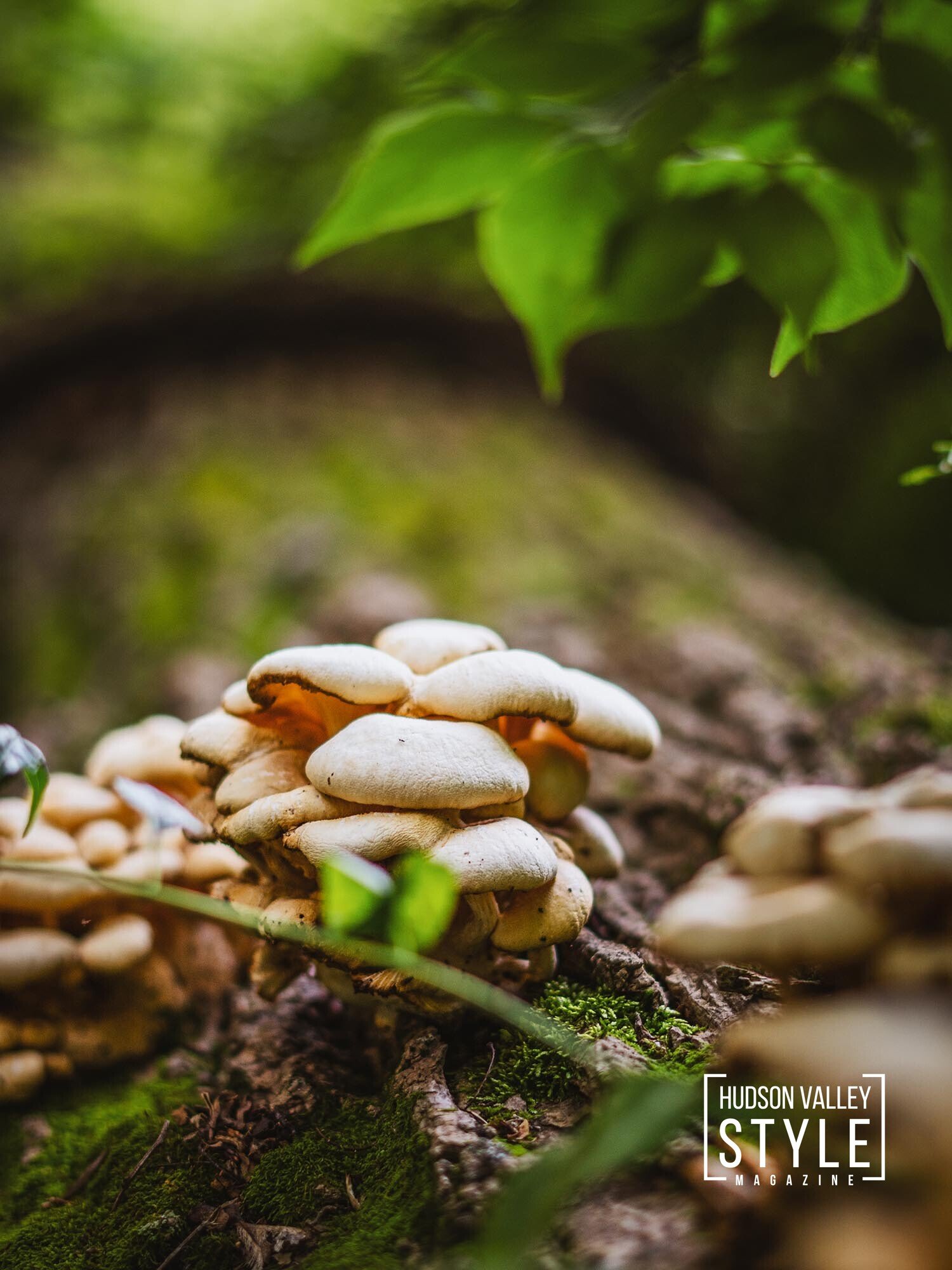
A fallen tree covered in mushrooms offers one of the forest’s most seductive reminders that nature operates through relationships. Fungi recycle organic matter, connect with plants through vast underground networks and release microscopic spores into the atmosphere. Research has shown that certain fungal spores can act as ice-nucleating particles, helping water freeze inside clouds and participating in processes connected with precipitation. Even mushrooms growing on a log beneath your boots belong to systems linking soil, air, water and weather. Suddenly the forest floor feels less like scenery and more like infrastructure designed by somebody with considerably better systems thinking than most corporate boards.

The Soil Has a Social Network, and Naturally the Fungi Built It First
Mycorrhizal fungi form partnerships with plant roots, exchanging nutrients and helping create the biological complexity that healthy soils depend upon. Modern regenerative agriculture increasingly recognizes the importance of protecting these relationships, especially as intensive tillage, pesticides, herbicides and other disruptive practices can reduce fungal communities and soil resilience. Add drought and broader climate pressures, and the wisdom of preserving living soil becomes beautifully obvious. Humanity spent generations trying to simplify ecosystems that function precisely because they are gloriously complicated. The mushrooms, meanwhile, have been networking underground the entire time. No LinkedIn Premium required.

Through the Trees, the Hudson Valley Opens
Perspective has a remarkable way of rearranging the mind. A hike moves attention between the intimate and the infinite, reminding us that both belong to the same reality and that our own thoughts occupy only one scale within it. This is where adventure therapy and mindfulness begin to overlap: less about controlling the mind and more about expanding its field of vision. Beauty gives attention somewhere generous to travel, and suddenly whatever felt enormous inside your head finds its place within something vastly larger, older and wonderfully alive.

The Hudson River Gives the Eyes Somewhere Beautiful to Wander
Meadow pours toward forest, the Hudson River catches the afternoon light, a bridge crosses the middle distance and mountains settle along the horizon. My earlier Hudson River nature photo story explored beauty as a form of intelligence, and landscapes like this keep making the argument for me. After hours spent looking at screens from approximately the distance of a canapé, allowing the eyes to travel toward a horizon feels luxurious. Follow the river. Trace the ridge. Notice how sunlight pools across the meadow. Emotional wellness occasionally has excellent production value.

Sunlight Turns a Hudson Valley Hike Into Visual Meditation
Golden light pours between tree trunks and transforms the woods into rhythm, depth and color. Photography taught me that mindfulness often begins before I consciously recognize it. The camera asks me to notice where light lands, how one trunk overlaps another, where green becomes yellow and how an apparently chaotic woodland reveals its own visual order when I stay long enough to see it. Hiking provides the movement. Photography provides the pause. Together they become a form of visual meditation in which the destination becomes wonderfully secondary because I am already exactly where I came to be.

A Fallen Tree Becomes a Tiny Mushroom Metropolis
Closer to the ground, oyster mushrooms turn a fallen tree into one of the forest’s more fabulous surprises. These fungi are powerful decomposers, capable of breaking down lignin and cellulose in dead wood and returning nutrients to the surrounding ecosystem. But here is the plot twist worthy of a gay nature documentary: oyster mushrooms are also carnivorous. Research on the predatory behavior of oyster mushrooms found that Pleurotus ostreatus produces microscopic toxin-bearing structures that rapidly paralyze tiny nematode worms, giving the fungus access to nutrients in the nitrogen-poor wood where it lives. Suddenly that elegant cream-colored mushroom looks considerably more femme fatale. Hiking adventures for mental health become richer through exactly this kind of curiosity and discovery: kneel down, look closer, learn one strange thing, and attention moves completely into the living world around you. Six inches above the forest floor, a mindful hike can open an entire universe.

Clover Has Been Running an Ecological Wellness Program Under Our Shoes
White clover becomes spectacular when photographed from its own height. Familiar blossoms rise above the grass like pale lanterns and suddenly an ordinary lawn becomes an entire miniature landscape. Clover is a legume, and through its relationship with nitrogen-fixing bacteria it can contribute biologically available nitrogen to the soil while its flowers provide nectar for pollinators. Human beings spent decades aspiring to immaculate monoculture lawns while clover was down here fertilizing soil and feeding insects for free. Who exactly earned the title of weed in this arrangement? I am increasingly suspicious that “weed” sometimes means “plant thriving beautifully without purchasing anything.”

Getting Down Into the Flower Changes the Scale of Everything
Photography rewards physical curiosity. Lower the camera into the grass and suddenly the world becomes enormous again. A clover blossom becomes architecture, a bee becomes wildlife and the horizon disappears behind blades of grass. That shift in scale carries its own emotional pleasure because it restores something adults tend to lose: the ability to become completely absorbed by something tiny. Mindfulness does not always require solemnity. Sometimes it looks like lying in a meadow with a camera while trying to convince yourself that the grass stain on your shirt is part of the artistic process.

A Forest Full of Flowers Makes Abundance Feel Entirely Natural
Seen from farther away, the bottlebrush buckeye becomes a constellation. Individual flower spikes dissolve into an entire woodland atmosphere, pale blooms floating beneath mature trees while sunlight catches each cluster differently. My Spring Awakening in the Hudson Valley photo story followed flowers as expressions of seasonal renewal; summer takes the idea into full abundance. Canopy above, shrubs below, fungi inside fallen wood, roots and microorganisms beneath the soil: nature’s preferred decorating philosophy appears to be maximalism. As a gay man, I feel represented.

Lavender Makes Mindfulness Smell Amazing
Lavender adds something photography can only suggest: fragrance. Walk close enough and the visual experience acquires another dimension, herbal, floral and immediately recognizable. Lavender has been extensively studied for its relationship with relaxation and anxiety, while its scent offers something even simpler on a mindful hike: an invitation to use another sense. Smell it before naming it. Notice whether a memory appears. Watch a bee disappear between purple flowers. Feel the warmth of the afternoon while you stand beside it. Sensory attention gives the mind somewhere pleasurable to land, and pleasure deserves considerably more respect in conversations about emotional wellness.

Fleabane Is a Wildflower, Darling, and It Has Been Waiting for Its Close-Up
The tiny white flowers brushed with lavender-pink appear to belong to the Erigeron genus, commonly called fleabane, with annual fleabane, Erigeron annuus, being a likely candidate. Native across much of eastern North America, it regularly appears along woodland edges, meadows and disturbed landscapes, where many people pass it without a second look. Through the lens, however, those threadlike petals and golden centers become almost ridiculously elegant. The entire plant seems designed to expose the absurdity of casually dismissing living things as weeds. Perhaps mindfulness occasionally begins when something we learned to overlook suddenly becomes gorgeous.

Wildflower, Weed, Native, Visitor: The Bee Has Declined to Review Our Categories
Getting interested in plants inevitably means getting interested in the stories humans attach to them: native, introduced, cultivated, naturalized, invasive, desirable, unwanted. The categories matter ecologically, but the camera also invites another form of attention. Look first. Learn next. Stay curious throughout. The bee hovering over a flower appears magnificently uninterested in our branding strategy, and I find that deeply restorative. Beauty often begins before classification.

Expanding Horizons Across the Hudson River
Expanding your horizons can be wonderfully literal in the Hudson Valley. After spending a mindful hike looking closely at flowers, fungi and the miniature universes beneath your feet, lifting your eyes toward the Hudson River changes the scale of thought itself. The Newburgh-Beacon Bridge stretches across the water between Dutchess and Orange counties, a human line drawn through an ancient landscape, connecting two shores while the river keeps moving beneath it. Hiking adventures for mental health offer this beautiful movement between scales: curiosity brings us close, perspective opens us back up. Adventure therapy can be as simple as letting the horizon become larger than whatever has been occupying your mind. The trail expands into the valley, the valley into mountains and sky, and suddenly possibility feels spacious again.

Beauty Travels Beautifully
Ecology deserves precision, while beauty deserves curiosity. An introduced species can alter a habitat and still produce an astonishing flower. A native plant can be dismissed as a weed and still feed pollinators. A mushroom can help recycle a forest while sending spores into the atmosphere. Clover can enrich soil beneath a lawn. Living systems constantly challenge the human appetite for tidy categories, which is one reason I keep photographing them. Beauty travels. Life travels. Humans travel. Seeds travel with considerably less paperwork. The deeper lesson of a mindful hike may be that belonging becomes more interesting when we approach it with knowledge, curiosity and enough humility to recognize beauty wherever life manages to bloom.

Yoga Belongs on the Trail Because the Body Belongs in the Landscape
Hiking, photography and yoga have gradually become different movements inside the same practice for me. Hiking carries the body through landscape. Photography makes me stop and see it. Yoga changes my awareness of the body experiencing it. A stretch beneath trees feels different from the same movement beneath fluorescent lights because wind, temperature, birdsong, fragrance and uneven ground become part of the sensory field. During my earlier Hudson Valley yoga and wellness travel story, the flowers surrounding my practice became part of the experience rather than decorative scenery. Walk, notice, breathe, stretch, photograph, continue. Wellness can be wonderfully uncomplicated when the body remembers it is also an animal living inside a landscape.

Emotional Wellness Can Begin With Falling in Love With the World Again
By the end of a mindful hike, nothing dramatic needs to happen because extraordinary things have been happening everywhere. Fungi are sending spores into the atmosphere. Clover is collaborating with bacteria beneath the grass. Pollinators are navigating flowers. Trees are converting sunlight into living tissue while the Hudson River moves through the valley beyond them. Science can explain pieces of these relationships, while experience offers another kind of knowledge: the sensation of becoming interested in the world again.

That is where my ongoing Emotional Wellness, Hiking Adventures, Mindfulness and Adventure Therapy photo stories live. Nature gives attention somewhere generous to go. Photography intensifies the encounter by asking me to see rather than merely pass through. Yoga brings awareness back into the body doing the seeing. The reward is movement, curiosity, pleasure, beauty and the lovely realization that the world becomes extraordinarily rich when we give ourselves permission to notice it.

Bring a Piece of the Visual Meditation Home
A selection of my fine-art nature photography and luxury photo prints is available through the Hudson Valley Style Magazine Gift Shop, extending these visual meditations beyond the trail and into the spaces where everyday life happens. More of my work can be explored through HARD NEW YORK Homoerotic Art Gallery, where nature, masculinity, desire, the human body and visual pleasure continue the same larger conversation. A forest can be meditation. A body can be landscape. Beauty, thankfully, has always known how to multitask.
Read next article: Wall Art That Works: Maxwell Alexander’s Fine Art Photography for Boutique Hotels, Wellness Spaces, and Private Collections