From New York Farm Winery License No. 1 to wood-fired pizza overlooking the Hudson River, Benmarl Winery tells a much larger story about experiential hospitality, local wine and the feeling of belonging in the Hudson Valley.
Benmarl Winery: Wine, History and the Feeling of the Hudson Valley – Story and Fine Art Photography by Maxwell Alexander, MA (FIT), BFA (SVA), Co-Founder of the People’s Hospitality Movement and Editor-in-Chief of Hudson Valley Style Magazine

Long before I lived in the Hudson Valley, I came here to practice yoga. New York City was home, while the Hudson Valley existed in my imagination as the place I escaped to when I wanted mountains, space, nature and whatever happens to the nervous system when buildings finally stop blocking the horizon. Somewhere along those trips I discovered Benmarl Winery, high above the Hudson River in Marlboro, New York.
Then something rather consequential happened: I fell in love with the Hudson Valley.
Years later, I somehow live in my vacation destination. New York City remains my first home in the geography of my imagination, obviously. A person can relocate upstate without surrendering all standards of civilization. Yet the Hudson Valley became my second home and eventually the landscape of everyday life. Looking backward through years of photographs, Benmarl appears again and again as one of the places where that relationship began.
My photographs tell the story better than chronology ever could. Grapevines descend a legendary slate hill toward an enormous Hudson Valley horizon. Sunflowers erupt beside weathered timber. Wine catches the afternoon light. Gardens soften architecture. An evolving sculpture assembled from massive pieces of driftwood stands at the edge of the property, turning the distant mountains and river into a living composition.
And then there is that view.

I have photographed luxury hospitality around New York and beyond, so I feel professionally qualified to use the technical architectural term here: billion-dollar view.
Beyond the vineyard, gardens and generations of human stewardship, the mighty Hudson River stretches across the horizon, connecting everything—the grapes growing on the hillside, the mountains beyond them, the communities along its shores and the history that brought all of us here. At Benmarl, the river never feels like a backdrop. It feels like the great connective force running through the entire experience.

Benmarl Winery and the Fine Art of Experiential Hospitality in the Hudson Valley
The photographs reveal something central to my research and practice in experiential hospitality: the experience begins before anybody serves you anything. A landscape can change our emotional state before a glass touches the table.
At Benmarl, the relationship between cultivated and natural landscape unfolds almost cinematically. Walk through the vineyard and agricultural rows lead the eye toward the mountains. Move through the gardens and flowers enter the composition. Sit down with a glass of wine and suddenly agriculture, weather, light, taste, landscape and human company occupy the same sensory field.
The driftwood sculpture may be my favorite expression of this idea. I have watched it evolve over years of visits, becoming more sculptural while maintaining its essential purpose: framing what was already there. Stand inside it and the Hudson Valley becomes the artwork.

Experiential design can be remarkably simple when it understands human perception. A frame tells the eye where to look. A garden changes the rhythm of movement. A vineyard connects the thing inside your glass with the earth directly beneath your feet. Beauty creates attention, attention creates presence, and presence allows memory to form.
At Benmarl, that monumental driftwood frame does something even more fascinating: it gives those memories a physical boundary. People step inside it for selfies and photographs with friends. Newlyweds stand there. Bachelor and bachelorette parties gather beneath it. Birthdays, anniversaries and ordinary afternoons become little ceremonies against the Hudson Valley horizon. Somewhere in the archive of human experience there may even be two men remembering a Valentine’s Day date during a snowstorm, because evidently we have always approached romance with excellent wine and questionable meteorological judgment.
The frame becomes a frame in time. For the fraction of a second when the photograph is made, the people inside it are elevated above the vineyard with the Hudson and mountains opening behind them—expansive, free, almost birdlike. Years later, the photograph can collapse the distance between then and now. We look at an image and suddenly remember the light, the person beside us, the wine, the weather, the way our bodies felt standing there. A tiny moment becomes accessible again.

Perhaps this is one of the beautiful ways experiential hospitality can extend our perception of time. We experience a place in the present, carry it forward as memory, and return to it through photographs, stories and future visits. The landscape remains while generations of human moments pass through the frame.
A rough piece of wood framing a horizon can therefore become much more than a design object. It can become part of the architecture of memory—a place where people briefly locate themselves inside the vastness of the Hudson Valley and preserve the feeling of being elevated, expansive and free.
Hospitality begins somewhere inside that feeling.
This relationship between landscape, emotional wellness, art and human experience is also part of an ongoing academic conversation in Hudson Valley Style Magazine’s Experiential Hospitality: Rethinking Wellness Travel Through Art, Nature and Privacy series. Benmarl offers an unusually clear real-world example: hospitality operating through visual composition, environmental psychology, agriculture, memory and human connection before the experience ever needs to announce itself as a concept.

The Historic Vineyard Behind Benmarl Winery in Marlboro, New York
The landscape beneath these photographs carries a history extending deep into Hudson Valley viticulture. Benmarl lays claim to America’s oldest vineyard, while the agricultural history of the Marlboro property reaches into the nineteenth century and the work of pioneering viticulturist Andrew Jackson Caywood, who cultivated grapes on this extraordinary hillside overlooking the Hudson.
The modern Benmarl story began in 1957, when Mark Miller and his family took over the property and gave it the name we know today. The Mark Miller and Benmarl Winery Collection at Cornell University explains that “Ben” derives from the Gaelic word for hill, while marl describes the soil. Cornell’s archive also records Miller as a wardrobe designer, illustrator and author who became deeply involved in New York’s wine industry and its legislation.

I love this enormously. Perhaps creative people have always wandered into the Hudson Valley, looked around at the mountains and eventually decided their previous careers required grapes.
Miller’s artistic background also feels remarkably appropriate here because Benmarl has always communicated through composition. Landscape, architecture, agriculture and hospitality work together. The estate never feels separated from the hill supporting it.

New York Farm Winery License No. 1 and the History of Benmarl
In 1976, Benmarl became part of a transformation in New York agriculture whose effects remain visible across the state’s wine regions today.
New York enacted the Farm Winery Act, creating a legal framework that allowed small wineries to sell directly to customers. Cornell’s history of the New York wine industry and the development of the farm winery system describes Mark Miller as instrumental in lobbying for the law’s passage.
Then Benmarl received New York Farm Winery License FW 1—the first Farm Winery License issued in New York State.
We have extraordinary historical documentation for this distinction. The Cornell University archive of Benmarl Winery and Mark Miller contains Farm Winery License FW 1 itself, dated November 4, 1976, and identifies it as the first Farm Winery License issued. Cornell’s archive also preserves a photograph of Governor Hugh Carey signing the Farm Winery Act on June 4, 1976 and the pen used to sign the legislation.

The contemporary legal descendant of that history remains visible in New York State Alcoholic Beverage Control Law §76-a governing Farm Winery Licenses.
That little license number tells a much larger story. New York wine could create value extending far beyond a bottle. People could travel to a farm, encounter its landscape, meet the people producing the wine, taste something connected to the land beneath them and participate directly in a local agricultural economy.
The wine became an invitation to experience a place.

Hudson Valley Wine, Agritourism and the Roots of People’s Hospitality
Nearly half a century later, we have a professional vocabulary for these relationships: agritourism, sustainable tourism, experiential hospitality, destination travel and the experience economy. Yet standing at Benmarl, I keep discovering that the underlying idea is beautifully simple.
People make something. Other people come to experience it.
Cornell’s archival history describes the 1976 Farm Winery Act and the expansion of New York farm wineries as transformative for the state’s wine industry because direct sales changed what was economically possible for small wineries.
A vineyard can therefore become much more than agricultural acreage. It can sustain farmers and winemakers while attracting travelers who eat at nearby restaurants, explore surrounding towns, visit other farms, discover artists and bring their own stories home with them. Agriculture creates an experience; the experience strengthens the relationship between people and place.
Years later, as Dino and I became co-founders of the People’s Hospitality Movement, I began recognizing something familiar in this history. The movement explores hospitality as a relationship among people, landscape, local creativity, stewardship and community prosperity. Benmarl never needed our terminology. Its history was already demonstrating how beautifully those relationships can work.
Discovering those connections feels less like inventing an idea and more like finding its roots.

The Spaccarelli Family and the Living Landscape of Benmarl Winery
The Spaccarelli family purchased Benmarl from the Miller family in 2006 and began another chapter in the property’s history. Over years of returning to Benmarl, I have watched that chapter become visible through the landscape itself.
Victor Spaccarelli Jr. brought something I find especially compelling as an experiential designer: hospitality elevated into an art form. Yet the human element remains beautifully direct. Victor is there. The Spaccarelli family is there. Over years of visits, we have seen them moving through the winery, welcoming guests, saying hello and remaining visibly connected to the everyday life of the place. That presence matters. Benmarl feels cared for by people you recognize and, with enough returns, people who recognize you.

Under the Spaccarelli family, the vineyard has also evolved into something of an experiential hospitality playground, where participation becomes part of the relationship between guest, wine and landscape. Grape stomping turns winemaking tradition into a wonderfully tactile ritual. Sangria festivals, live music, seasonal celebrations and gatherings bring people onto the hill to participate rather than merely observe. Friends return together, families make traditions around annual events, and the vineyard becomes a social landscape where community forms through shared experience.
That evolution feels especially true to Benmarl because the spectacle never overwhelms the place itself. The grapes remain beneath your feet, the Hudson remains on the horizon, and the family remains present within the experience. Hospitality becomes participatory: people making wine, people celebrating wine, people meeting one another through wine, all on the land where the story begins.
We have seen the transformation gradually—the deck, the gardens, the landscaping, the little stage for live music, flowers filling the property, estate grapes becoming an even more commanding presence across the hillside and the driftwood sculpture growing more beautiful with time. Each visit contains something familiar and something newly considered.
That continuity matters because experiential hospitality depends on stewardship. A beloved place can evolve without surrendering the character that made people love it. Benmarl feels cared for rather than completed.

The vineyard may be the most powerful expression of that stewardship because it brings human intention and natural landscape together. Rows of vines introduce geometry across the hill while following its contours toward the Hudson. Agriculture becomes part of the visual composition, and the view becomes inseparable from the work required to maintain it.
Benmarl’s own winemaking philosophy and approach to Hudson Valley terroir connects contemporary wine production with sustainability, changing environmental conditions and responsibility toward the land. The vineyards visible in these photographs therefore function as both landscape and source: what we see around us ultimately enters the glass.

Wood-Fired Pizza, Hudson Valley Wine and a Billion-Dollar View
Then somebody had the magnificent idea to add brick-oven pizza.
Pizza arrives. Wine arrives. The Hudson River Valley performs shamelessly in the background. What exactly am I supposed to criticize?
The brilliance lies in how naturally the experience comes together. Wood-fired pizza carries the warmth and informality that makes people stay at a table. Wine encourages attention to taste and conversation. The landscape provides the theater. Nothing competes for dominance.
Benmarl’s Slate Hill wines make the connection almost poetic. The hill enters the vineyard, the vineyard enters the wine, the hill enters the name and the actual landscape stretches beyond your glass.
Terroir suddenly becomes wonderfully easy to understand. You can see it.

Sunflowers, Gardens and the Emotional Landscape of Benmarl
My photographs keep returning to the flowers.
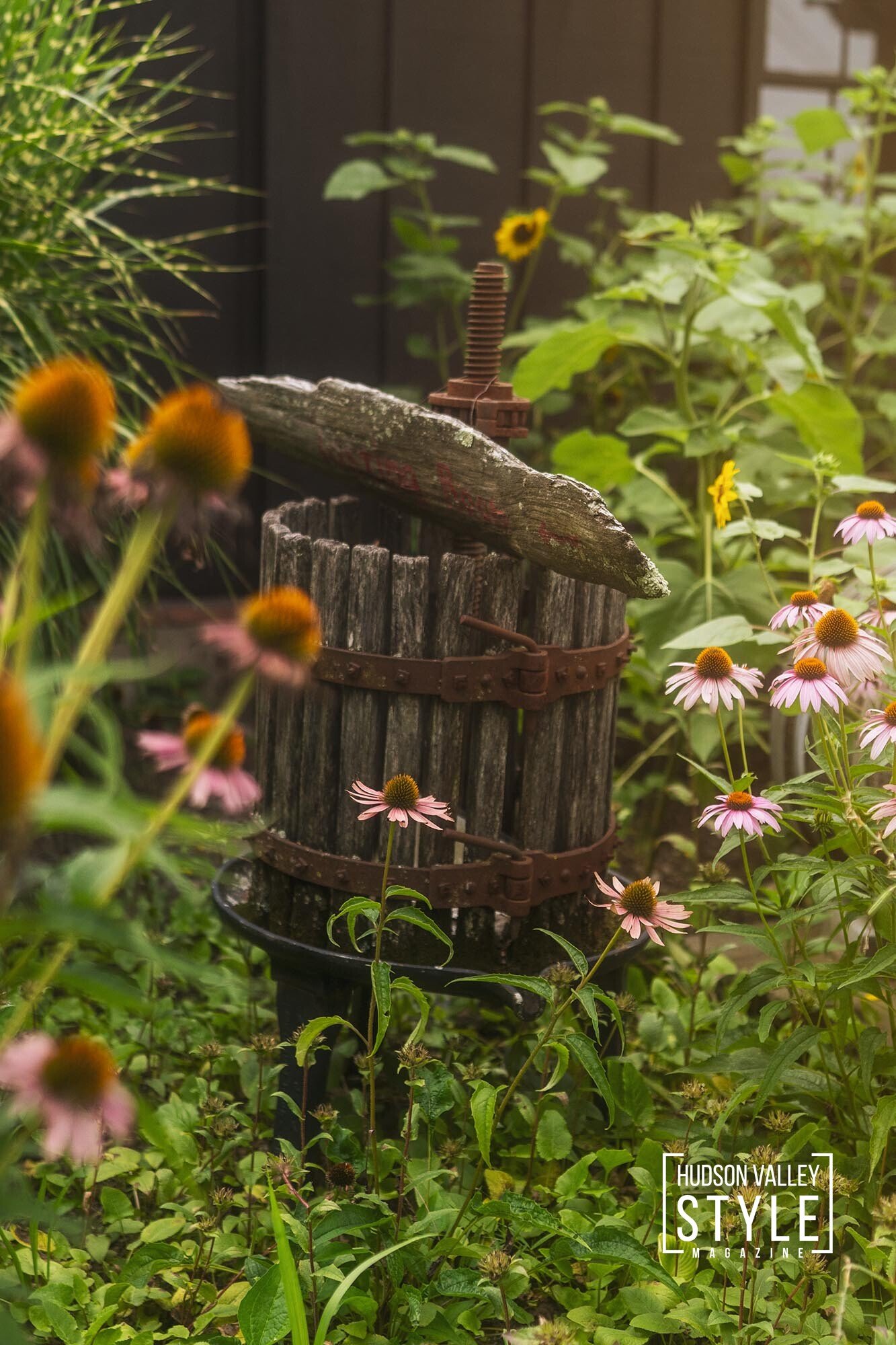
The sunflowers surrounding Benmarl provide far more than decoration because gardens change how people inhabit space. Flowers invite wandering. They slow movement and introduce color, fragrance, texture and seasonality into the experience of a property.
Positive psychology gives us useful language for understanding why environments like this matter. Experiences of natural beauty can support positive emotion, attention, connection and a sense of awe. Within our broader Experiential Hospitality series, these relationships between environmental design and emotional wellness form a recurring field of inquiry: how does a place help people feel more present, connected and alive?
Benmarl offers those conditions generously. The gardens lead into vineyards. Vineyards lead toward mountains. The mountains descend toward the Hudson. Wine connects the sensory experience back to the agricultural landscape.
The result feels whole.

The Fairytale Cottage at the Edge of the Vineyard
Then there is the little bed-and-breakfast tucked into the landscape.
I have always loved it because its scale feels almost improbable against the enormous view. Rather than competing with the landscape, the cottage seems to belong to the fantasy of the place: a tiny human shelter perched within vineyards and gardens above the Hudson Valley.
Its intimacy also illustrates another principle of experiential hospitality. Scale affects emotion. Small spaces can create powerful feelings of discovery, privacy and belonging because they allow us to understand where we are in relation to the landscape around us.
A little cottage on a vineyard can become unforgettable because the human scale makes the enormous scale of the valley feel even more spectacular.

A Snowy Valentine’s Day at Benmarl Winery
My clearest memory of Benmarl hospitality contains almost none of the elements normally scored in a winery review.
It was February. Valentine’s Day. Snow. Dino and I decided we were going on a date, and he happened to be driving a tiny two-door sports car—an inspired transportation choice for a snowy Hudson Valley vineyard sitting on the side of a hill.
Eventually physics became involved.
We left the car near the main road and walked through the snow toward Benmarl. When we reached the winery, the doors were open. We were the only guests that day, yet the welcome felt every bit as complete as it would have on a packed harvest weekend. We drank wine together while snow covered the landscape outside, and somewhere inside that wonderfully improbable Valentine’s Day adventure, Benmarl became more than a winery we liked visiting.

Benmarl felt like home.
It has felt that way ever since.
Years later, that memory also helped me understand hospitality more clearly. I remember the feeling before I remember what was poured into the glass. Hospitality had transformed an ordinary commercial interaction into a human memory, and the memory became part of our relationship with the place.

The Benmarl Wine Club and the Beautiful Value of Returning
Dino and I have belonged to the Benmarl Wine Club for more than a decade, and I love its beautifully uncomplicated proposition. Members commit to buying wine throughout the year and receive benefits that encourage them to return, taste and continue the relationship with the winery.
Support the vineyard by drinking the wine.
I can manage this burden.

More importantly, the wine club creates continuity. A shipment becomes another vintage to discover. A tasting becomes another reason to return to the hill. Member benefits make bringing bottles home part of everyday life rather than preserving the experience as something available only during a special occasion.
Over time, those returns become memories layered upon memories. You notice a new garden. The vines have grown. The deck has changed. The driftwood sculpture has evolved. Victor is there. Another vintage arrives in the glass.
The vineyard becomes familiar without losing its magic.

Fine Art Photography as Experiential Hospitality Research
Photography has always been my primary research instrument.
When I photograph Benmarl, I am recording objects, but I am studying relationships: wine against flowers, agricultural rows against distant mountains, human-scale architecture against an enormous landscape, cultivated gardens beside weathered wood, sunlight passing through a glass.
Fine art photography allows me to investigate something conventional hospitality metrics struggle to capture: how a place feels.
Beauty changes human experience. Landscape changes human experience. Being welcomed changes human experience. Memory changes the next experience when we return.
This photographic approach sits at the center of my ongoing exploration of wellness travel through art, nature, privacy and experiential hospitality. Photography becomes more than documentation in this context. It functions as embodied research: evidence of how relationships among environment, design, landscape and human presence create emotional experience.

The photograph preserves evidence that the physical moment existed, yet its greater power comes from translating the emotional experience of being there. A wine glass can become a memory of an afternoon. Sunflowers can become a season. A vineyard can become the first chapter in someone’s relationship with an entire region.
That is why reviewing Benmarl as though I arrived yesterday with a clipboard would make little sense.

Hudson Valley Style Magazine has been writing about Benmarl for years. It appeared naturally in our Marlboro adventures long before this essay. We incorporated Benmarl into our Hudson Valley travel stories, poured its wine into our winter wellness photography and included the estate among our romantic Hudson Valley winery destinations.
It turns out we have been conducting a longitudinal study.
Very rigorous. Lots of Cabernet Franc.

Benmarl Winery and the Living History of People’s Hospitality
The experience economy gave us useful language for something humans have always understood intuitively: people value how a place makes them feel. In experiential hospitality design, wine, food, architecture, landscape, service, music, light and human interaction become parts of one emotional environment. The experience reaches beyond delivering a product or completing a transaction. We are creating the conditions in which people can feel pleasure, connection, curiosity, belonging and awe—and carry those feelings home as memories.

Benmarl makes that idea wonderfully tangible because the experience feels inseparable from the people creating it. Victor Spaccarelli Jr. is there. His family is there. The grapes are growing on the hill outside. The pizza comes from the oven while the Hudson stretches across the horizon. Gardens planted and cared for by human hands become part of the visual experience. Guests return often enough to recognize the people behind the place and, eventually, to be recognized themselves. Authenticity grows through those relationships.
Researching Benmarl’s history and Farm Winery License No. 1 gave me an unexpected gift: I began discovering the historical roots of ideas we are exploring today through the People’s Hospitality Movement: by the people, for the people. The connection does not require claiming Benmarl for a movement that came decades later. The opposite feels much more meaningful.

People throughout the Hudson Valley have been practicing versions of these values for generations. Farmers grew things. Winemakers transformed agriculture into craft. Families cared for land. Visitors followed wine back to the landscape where it originated. Hospitality gave those visitors a reason to stay. Relationships formed. People returned. Local prosperity and human happiness became connected through experience.
The People’s Hospitality Movement describes hospitality as something created through human relationships, local culture and the communities that give a destination its identity. Prosperity circulates through farmers, artists, craftspeople, homeowners, restaurants, hospitality professionals and neighboring businesses while travelers receive something equally valuable: genuine connection with a place.

Benmarl allows me to see that philosophy through a much longer historical lens. New York Farm Winery License FW 1 represents a moment when New York gave small agricultural producers greater power to welcome people directly into the world surrounding what they made. The product became an invitation to experience the place, and the experience created reasons to return, bring friends, buy another bottle and build a relationship with the people and landscape behind it.
That relationship sits at the heart of experiential hospitality design. Authentic experience grows through stewardship, personality, continuity and genuine human presence. A family cares for a vineyard. People welcome other people into it. Food, wine, art, agriculture and landscape create the setting, while human connection gives the setting meaning.

Decades after Farm Winery License No. 1, standing among Benmarl’s grapes with the Hudson on the horizon, the relationship between agriculture, hospitality, landscape and community feels wonderfully alive. The economics follow the feeling because people naturally want to support places where they feel connection, joy and belonging.
Perhaps that is the most valuable currency in the experience economy: the feeling that something real happened to you while you were there. Movements can have roots far older than their names.

Why Benmarl Winery Still Feels Like the Hudson Valley
My photographs of Benmarl contain the same horizon I encountered when I first came to the Hudson Valley for yoga, yet almost everything around it has evolved.
Benmarl changed. The vineyard changed. The gardens changed. The driftwood sculpture changed. Dino and I changed. I changed careers, businesses, ideas and eventually my relationship with the Hudson Valley itself.
The vacation destination became home.
Yet I can stand on that hill with a glass of wine and recognize its emotional geography immediately. The mighty Hudson remains on the horizon, connecting landscape and history, agriculture and culture, memory and whatever comes next.
Perhaps the greatest hospitality gives us coordinates—not latitude and longitude, but a way of locating ourselves inside our own lives.
Benmarl’s history can be documented through vineyards, bottles, archives and legislation. Cornell University preserves Benmarl’s Farm Winery License FW 1 and the pen connected to the legislation that helped reshape the New York wine industry.

My archive contains something different: sunflowers glowing beside the vineyard, wine catching sunlight, pizza shared above the Hudson, grapes descending the slate hill, an evolving wooden sculpture framing the horizon and a landscape I once traveled north from New York City to experience.
It contains the memory of two men walking through February snow because their sports car had surrendered to the hill, arriving to find an open door and a winery waiting for them.
Years later, I understand why that memory stayed with me. Hospitality gave me a feeling. Over years of returning, the feeling became a relationship with the people, the vineyard and the landscape around it.
And somewhere along the way, I realized the Hudson Valley had become home. Then again, I’ve decided New York City is simply the southern end of the Hudson Valley, so technically I never left home at all.