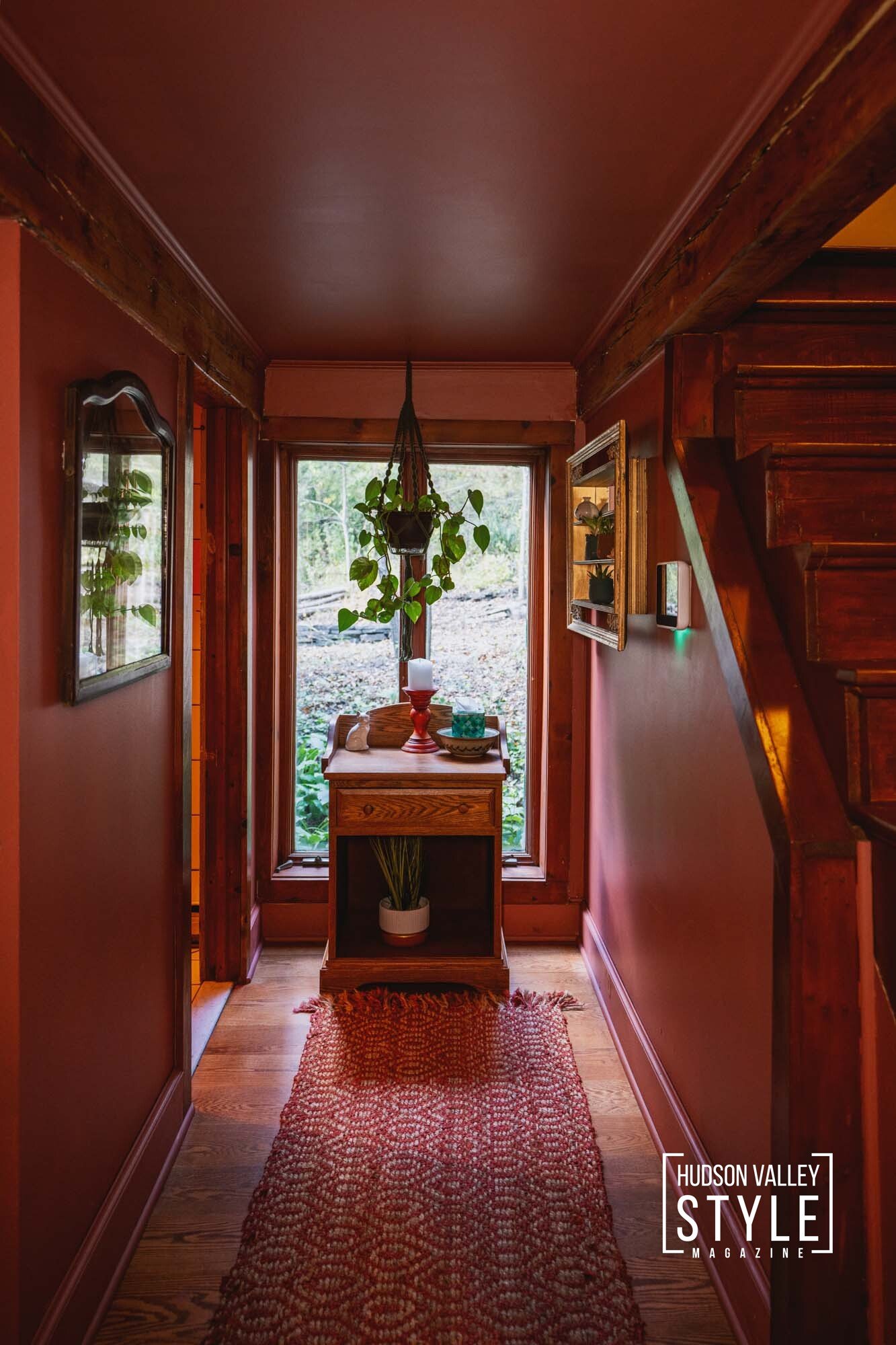


HUDSON VALLEY, N.Y. — A smooth river stone on a wooden ledge can change how a room feels before a guest has finished unpacking. In Episode 3 of Experiential Hospitality 101, Maxwell Alexander examines how natural objects, from found stone and weathered driftwood to dried grasses and bare branches, shape emotional experience inside hospitality interiors. Grounded in environmental psychology, the object research of Brenda Cowan and his own fine art photography across Hudson Valley and Catskills properties, the visual study proposes emotional materiality as a working principle for experiential hospitality and wellness interior design.
Designing Feelings: Natural Objects and the Emotional Architecture of Experiential Hospitality – Experiential Hospitality 101 with Maxwell Alexander, MA(FIT)/BFA(SVA) – Wellness Interior Design – Photography and Visual Study by Maxwell Alexander

Can We Design Feelings?
In the first episode of Experiential Hospitality 101, I proposed a deceptively simple idea: hospitality is the design of human experience, and rooms, amenities and services are only its instruments. Architecture, privacy, art, landscape, objects, light, sound, and even the direction in which we place a chair participate in determining how a guest feels in a space. Episode 2 followed that idea into scent and memory. If we accept the premise, the next question becomes considerably more interesting: can we intentionally design feelings?
The question has little to do with emotional manipulation, or with the increasingly familiar technological obsession with optimizing every measurable moment of human existence. Experiential hospitality runs in almost the opposite direction. It asks how an environment can create the conditions for feelings to emerge naturally: tranquility, curiosity, sensuality, belonging, privacy, pleasure, connection, or simply the increasingly rare sensation of being fully present in a place.
For this episode, my practice-based experiment began with two of the oldest design materials available to humanity: stone and wood. More specifically, smooth found stones and pieces of weathered driftwood, placed with restraint in hospitality interiors alongside dried grasses, seed heads and branches, and photographed as part of my continuing research into wellness, materiality, sustainability, and emotional experience.
Emotional Materiality in Wellness Interior Design
Interior design traditionally gives us an extensive vocabulary for discussing form, proportion, scale, balance, texture, color, materiality, and composition. Hospitality design adds another layer of operational considerations: circulation, durability, maintenance, occupancy, service, and guest expectations. Experiential hospitality introduces another question into this vocabulary: what emotional conditions does the environment create?
A room can be expensive and emotionally exhausting. It can be impeccably styled yet somehow sterile. It can photograph beautifully while giving the nervous system absolutely nowhere to land. Conversely, an extraordinarily simple interior can feel restorative because its materials, light, views, textures, and objects work together without competing for attention.
This is where material becomes emotional. Stone has weight, temperature, texture, and geological irregularity, and it also carries associations with landscape, permanence, water, mountains, gardens, ritual, and time. Weathered wood contains another emotional vocabulary: age, warmth, erosion, imperfection, movement, and transformation. We perceive these qualities before we consciously intellectualize them.
I think of this dimension of design as emotional materiality: the experiential quality of a material created through the feelings, memories, associations, and behaviors it makes possible within a space. In experiential hospitality, material specification therefore becomes emotional specification as well. The question grows from whether an object looks appropriate in the room to what its presence allows the room to feel like.

Bringing the Zen Garden Indoors
The inspiration for this experiment is partly rooted in the aesthetics and philosophy of Japanese dry landscape gardens, or karesansui, which I explored in the first episode of Experiential Hospitality 101. In these gardens, stone, gravel, vegetation, negative space, and carefully controlled views become instruments of attention. Their power comes from restraint.
The contemporary wellness industry could learn from this. We have become remarkably skilled at announcing wellness. There are wellness menus, wellness packages, wellness technologies, wellness beverages, wellness itineraries, and occasionally so much wellness programming that one may require a restorative vacation after completing it.
A stone asks considerably less of us.
Placed beside a bath, on a wooden surface, near a window, or within an otherwise restrained composition, a smooth stone becomes a small visual anchor. It introduces an organic shape into architectural geometry and creates a calm relationship between the controlled interior and the less controlled landscape outside.
Reproducing a Japanese Zen garden as decoration would reduce a sophisticated cultural and philosophical tradition to an aesthetic theme. Experiential hospitality can instead learn from its underlying spatial intelligence: restraint, asymmetry, contemplation, natural material, negative space, and the careful direction of attention. We study the garden, and we leave the copying to theme parks.

Natural Tranquilizers and the Architecture of Attention
I have begun referring to stones and driftwood, somewhat playfully, as natural tranquilizers. Obviously, I am making an aesthetic claim with nothing pharmaceutical about it; no river rock has yet survived peer review as a controlled substance. The phrase describes what I repeatedly observe in practice: natural forms can lower the visual volume of an interior.
Environmental psychology gives us useful language for understanding why this may matter. Rachel and Stephen Kaplan’s Attention Restoration Theory proposes that certain environments can support recovery from the fatigue produced by sustained directed attention. One of the most compelling concepts associated with the theory is soft fascination: the ability of certain environments and phenomena to engage attention gently, while leaving most of our cognitive resources free.
That idea has continued to develop in environmental psychology. In their research on soft fascination and mental bandwidth, Avik Basu, Jason Duvall, and Rachel Kaplan argue that softly fascinating experiences require relatively little attentional effort while leaving mental space available for reflection.
Water moving, clouds passing, leaves shifting in the wind, fire flickering, or light traveling across a textured surface can engage us while demanding nothing in return. Natural objects can create similar micro-moments indoors. The irregular surface of a stone, the sculptural line of driftwood, or the changing shadows around either object can give attention a calm place to rest.
This extends the central claim of the first Experiential Hospitality 101 story: attention itself is becoming a luxury. Contemporary environments constantly compete for it, while restorative environments may distinguish themselves by giving some of it back.

Objects as Active Participants
This investigation also connects with the work of Brenda Cowan, Ross Laird, and Jason McKeown and their interdisciplinary research collected in Museum Objects, Health and Healing: The Relationship Between Exhibitions and Wellness. Their work develops the theory of Psychotherapeutic Object Dynamics, examining how relationships between people and objects can participate in memory, identity, emotional experience, and wellbeing.
One observation from the book’s introduction is central to experiential hospitality: “Observation itself is an active state.” The authors add that this holds most strongly when the design of an environment encourages connection, keeps distraction away and looks after the basic comfort of the visitor. That reads remarkably like a brief for a well-designed guest room.
An object needs no screen, motor, sensor, or interactive interface to create an interaction. Looking is an interaction. Touching is an interaction. Remembering a place because of an object is an interaction. Wondering about its origin, feeling its temperature, noticing its weight, or associating its shape with a landscape from one’s own memory are all forms of participation.
This gives us a more sophisticated way to think about decorative objects in hospitality interiors. Moving from the question of what object will fill an empty shelf to the question of what relationship an object might invite sounds like a small step, yet conceptually it carries us from decorating space toward designing experience.

Driftwood and the Beauty of Transformation
Driftwood introduces a different emotional register. Where stone communicates mass and geological patience, driftwood carries visible evidence of transformation. Water, weather, friction, and time have edited it into sculpture long before the designer arrives.
Placed within an interior, driftwood creates line, movement, irregularity, and shadow. Against the precision of cabinetry, tile, glass, and architectural surfaces, its unpredictability becomes especially expressive. It can function visually like abstract sculpture while remaining exactly what it is.
Dried grasses, seed heads and bare branches belong to the same family of objects: plant material at the end of its season, holding its line and color long after the garden has let go.
The object also has a beautifully democratic quality. Its design value owes nothing to a luxury brand, a recognizable signature, or an artificially generated scarcity. Its value emerges through attention and context. The designer’s role becomes one of seeing, selecting, cleaning, positioning, and composing, with purchasing demoted to a supporting part.
This is where the practice intersects naturally with both art and hospitality. A weathered branch beside a river is part of a landscape. Placed deliberately inside a room, it becomes part of a composition. Photographed within that composition, it becomes an image. Encountered by a guest, it becomes an experience. The material has changed very little; the relationships surrounding it have changed completely.

Fine Art Photography as Practice-Based Research
Because this series exists simultaneously as research, hospitality practice, and fine art photography, the camera does more than document a finished design. Photography becomes part of the research method itself.
Moving the same types of natural objects through different properties allows me to observe how their emotional and visual qualities change according to architecture, surface, light, scale, and context. A pale stone against white linen can become almost meditative, while the same form against dark timber suddenly acquires weight and contrast. A piece of driftwood may read as organic against rigid architecture and unexpectedly architectural against a soft landscape.
The photographs accompanying this story are therefore part of the claim as much as illustrations of it. Experiential hospitality is being tested here at the scale at which guests actually encounter it: a bathroom shelf, a bedside surface, a window, a still corner, a tactile object noticed for several seconds while moving through a room.
This is pop academia with a very attractive lighting department, and it is practice-based research all the same.

Sustainability Begins With What Already Exists
There is another reason this experiment matters. Hospitality has developed an enormous appetite for decorative objects, many of which are manufactured, packaged, shipped around the world, installed briefly, replaced when aesthetic trends change, and eventually discarded. Sometimes they are made from petroleum-based materials engineered to imitate natural materials that were already available without the petrochemical cosplay.
Sustainable interior design requires us to reconsider this cycle at the level of individual objects. Before asking what we should purchase for a room, perhaps we should ask what already exists.
Responsibly collected natural materials, reclaimed timber, vintage objects, locally made pieces, and existing objects given new contexts offer a different model. Found materials should, of course, be gathered with ecological judgment and respect for protected landscapes and local regulations. “Nature is free” makes a poor sustainability policy.
The larger principle is that design value can begin with noticing, long before manufacturing. The creative act can be selection, placement, juxtaposition, and reuse. Sustainability then becomes part of the aesthetic intelligence of the room itself, in place of a separate certification attached to the design after the fact.

Local Nature and the Experience of Place
For hospitality, this approach has another important consequence: it strengthens a guest’s relationship with place.
Environmental psychology uses the concept of place attachment to describe the affective, cognitive, and behavioral ties people develop with their environments. For hospitality, that raises an interesting design problem. If travel is fundamentally an encounter with place, why are so many hospitality interiors designed to minimize the specificity of where they actually are?
One of the peculiar contradictions of contemporary travel is that we can cross continents only to enter interiors assembled from the same visual vocabulary. The same furniture, the same vaguely Scandinavian lighting, the same decorative accessories, the same neutral palette, and the inevitable bowl containing three mysterious beige spheres. We have achieved the remarkable feat of making everywhere available while making everywhere look increasingly like nowhere.
Experiential hospitality should resist that flattening.
A Hudson Valley hospitality experience should communicate the Hudson Valley. The relationship can stay subtle, far from literal or theatrical. Nobody needs a plaque explaining the biography of every stone. In fact, the absence of explanation can make the encounter more powerful.
Local geology, wood, vegetation, craftsmanship, art, landscape, light, weather, and cultural history can enter the interior without announcement. Guests then experience nature both outside and inside the property. The boundary between landscape and accommodation becomes more porous, and the room begins to feel situated rather than styled.
Call it hospitality with a sense of place, the opposite of a theme.

Wellness Interior Design Without Performing Wellness
This material approach also expands my ongoing research into wellness interior design. Wellness can exist without appearing as an activity the guest is expected to perform.
Sometimes wellness is simply an environmental condition.
Roger Ulrich’s landmark 1984 study, “View Through a Window May Influence Recovery from Surgery,” became foundational to evidence-based discussions about natural environments and wellbeing. In the study, surgical patients whose windows faced a natural scene had shorter postoperative stays and other more favorable outcomes than matched patients whose windows faced a brick wall. The study stopped well short of proving that every natural object is therapeutic, yet it helped establish an influential research trajectory examining the relationship between environmental design, nature, stress, and recovery.
Privacy can support wellness. Silence can support wellness. Natural light, visual restraint, tactile materials, views of landscape, and opportunities for unstructured attention can all contribute to how restorative a place feels. A room can participate in emotional wellness before anyone rolls out a yoga mat.
This distinction matters because contemporary wellness culture can occasionally turn restoration into another form of labor. Guests are instructed to meditate, breathe correctly, journal, plunge, stretch, detox, optimize sleep, monitor biometrics, and drink a green liquid before breakfast. The pursuit of wellbeing begins to resemble an internship.
Experiential hospitality proposes a gentler approach. Instead of requiring guests to perform wellness, we can design environments that make restoration easier to encounter naturally.

Designing Feelings Without Dictating Them
The phrase “designing feelings” requires an important qualification. Designers cannot determine what another human being will feel, nor should they attempt to. Every guest enters a space carrying memories, expectations, cultural associations, desires, anxieties, and an entire personal history that the interior designer has not been invited to edit.
What design can create are conditions of possibility.
Privacy makes solitude possible. A chair facing a landscape makes contemplation possible. A path makes wandering possible. A tactile object makes curiosity possible. Natural material can make sensory connection possible. Visual calm can make decompression possible.
None guarantees an emotional outcome. This is the ethical distinction between designing feelings and controlling them. Experiential hospitality prescribes no emotion. It creates emotional affordances: environments in which certain forms of experience become more available.

The People’s Hospitality Movement: People, Place, Planet, Presence
These ideas connect directly with the People’s Hospitality Movement, which I co-founded as a broader inquiry into what a more human, democratic, locally grounded, and sustainable hospitality culture might look like.
If Experiential Hospitality is the theoretical framework, the People’s Hospitality Movement is one way of putting those principles into practice. Both begin from the understanding that hospitality exists among people, communities, environments, cultures, and places, well beyond a commercial exchange between a company and a customer.
Four principles increasingly connect this work: people, place, planet, and presence.
People, because hospitality ultimately exists to serve human experience. Place, because meaningful travel should connect us to a location rather than reproduce the same aesthetic everywhere. Planet, because an industry whose economic value depends heavily on beautiful landscapes has a rather obvious obligation to keep them intact while it shops for decorative accessories. Presence, because one of the greatest luxuries hospitality can now provide is the opportunity to actually notice where we are.
Hospitality for the people, by the people, should also mean hospitality that respects the places those people inhabit.

Let Nature Do Some of the Designing
The practical interior design lesson from all of this is surprisingly uncomplicated. Before adding another decorative object, look outside.
Study the local landscape. Notice its materials, shapes, textures, colors, irregularities, and evidence of time. Consider what can be responsibly found, reclaimed, reused, or sourced locally. Bring those materials inside sparingly and give them enough negative space to remain visible.
Place stone against linen. Let driftwood cast a shadow against plaster. Put an irregular organic form against precise architectural geometry. Allow natural light to change the composition throughout the day. Resist the impulse to keep adding things merely because an empty surface has offended us.
The goal is a room that maintains a relationship with nature, which is a different thing from a room filled with it.
This may be one of the simplest principles of sustainable experiential design: let nature do some of the designing.

Experiential Hospitality and the Luxury of Enough
The first episode of Experiential Hospitality 101 proposed that attention may be one of the emerging luxuries of contemporary travel. This episode extends that idea into material culture.
If modern environments constantly compete for our attention, sophisticated hospitality can distinguish itself by occasionally refusing to compete. Natural materials, visual restraint, tactile objects, local character, privacy, and negative space can create interiors that hold back from constantly announcing themselves.
Perhaps this is also where sustainability and emotional wellness finally meet. Both ask us to reconsider the assumption that more is necessarily better. More products add no automatic richness to an interior, just as more programming adds no automatic rest to a vacation.
Sometimes a stone is enough. Sometimes a piece of weathered wood is enough. Sometimes the most meaningful design intervention is simply recognizing what was already there and giving it a place to be noticed.

That is what I mean by designing feelings: creating environments where feeling has room to happen, composing attention, and allowing the character of the landscape to enter the experience.
Experiential hospitality is ultimately about designing relationships between people, objects, nature, place, and their own attention; rooms are simply where those relationships happen. And in an industry perpetually searching for the next amenity, the next trend, and the next thing to sell as an upgrade, there is a wonderfully radical pleasure in discovering that the next great luxury object may have been sitting beside the river the entire time.
// Discover More Experiential Hospitality 101 with Maxwell Alexander →
// Subscribe to HVSM Newsletter →
For readers 18+: the adult chapter of this conversation, on queer art, sexuality and wellness interiors for gay men, continues in GUY STYLE MAG with The Pleasure Economy: Homoerotic Wall Art, Queer Wellness Interiors and the Future of Hospitality for Gay Men.
Research and Theoretical Sources
- Alexander, Maxwell. “Experiential Hospitality: Rethinking Wellness Travel Through Art, Nature, and Privacy.” Hudson Valley Style Magazine, 2026. Episode 1 of Experiential Hospitality 101.
- Alexander, Maxwell. “The Architecture of Scent: Aromatherapy, Memory, and Sensory Wellness in Experiential Hospitality.” Hudson Valley Style Magazine, 2026. Episode 2 of Experiential Hospitality 101.
- Cowan, Brenda, Ross Laird, and Jason McKeown. Museum Objects, Health and Healing: The Relationship Between Exhibitions and Wellness. Routledge, 2019. See the Introduction for the passage on observation as an active state.
- Cowan, Brenda. “Psychotherapeutic Object Dynamics: The Theory.” Psychotherapeutic Object Dynamics.
- Basu, Avik, Jason Duvall, and Rachel Kaplan. “Attention Restoration Theory: Exploring the Role of Soft Fascination and Mental Bandwidth.” Environment and Behavior, 2019, 51(9–10), 1055–1081.
- Kaplan, Rachel, and Stephen Kaplan. The Experience of Nature: A Psychological Perspective. Cambridge University Press, 1989.
- Ohly, Heather, Mathew P. White, Benedict W. Wheeler, Alison Bethel, Obioha C. Ukoumunne, Vasilis Nikolaou, and Ruth Garside. “Attention Restoration Theory: A Systematic Review of the Attention Restoration Potential of Exposure to Natural Environments.” 2016.
- Ulrich, Roger S. “View Through a Window May Influence Recovery from Surgery.” Science, 1984, 224(4647), 420–421.
- Yarker, Sophie, et al. “Theorizing ‘Place’ in Aging in Place: The Need for Territorial Perspectives.” The Gerontologist, 2024.