Brasserie Cognac Américain: A Photo Story on French Brasserie Design, Hospitality, and the New York Dining Scene – Restaurant Reviews with Maxwell Alexander, MA(FIT)/BFA(SVA), EIC, Hudson Valley Style Magazine

New York’s Midtown district has always been a proving ground for hospitality design. Between Bryant Park and the theater district, restaurants compete for attention not only through cuisine but through architecture, lighting, and the kind of visual drama that photographs as beautifully as it dines. Brasserie Cognac Américain enters that conversation with confidence.
Towering walls of backlit bottles glow in shades of amber and gold, turning the bar into a luminous monument. Brass catches the afternoon light. Velvet seating wraps around polished marble tables. A grand staircase draws the eye toward a second dining room above. Warm reds and golden amber tones saturate every corner, creating a palette built for the camera as much as for the guest.

As a study in French brasserie interior design, it stands among the city’s most photogenic rooms. The nearly 12,000-square-foot space unfolds across two levels, anchored on the ground floor by a sweeping horseshoe-shaped bar and a main dining room built around warm wood and polished brass. Every surface seems calibrated for the camera as much as for the guest—marble tabletops that catch and hold light, brass fixtures polished to a mirror finish, velvet upholstery deep enough to swallow shadow and give it back as texture. It’s a design language drawn deliberately from the great European brasseries, filtered through the scale and energy of Midtown Manhattan, with a color palette that does much of the work on its own: warm reds bleeding into gold, amber undertones threading through every material choice. Few dining rooms near Bryant Park commit this fully to a singular aesthetic vision, and fewer still translate that vision so effortlessly from architecture into image.

The Ritual of Bread and Butter
French dining has always understood the visual and sensory power of simple things. Bread and butter, plated with intention, remain one of the great subjects of French food photography—texture, crumb, and golden crust captured under warm light.

At Brasserie Cognac Américain, the baguette arrives styled for the frame: a rustic silhouette against white linen, a study in shadow and highlight that any photographer working the French cuisine beat will recognize immediately.

French cuisine has elevated bread into one of the world’s great visual rituals, and this table honored that tradition frame by frame. In 2022, UNESCO added the artisanal know-how and culture of baguette bread to its list of intangible cultural heritage, recognizing it not as a side dish but as a daily social ritual central to French life. The traditional baguette is made from just four ingredients—flour, water, salt, and leaven or yeast—shaped by hand and marked with the baker’s signature cuts before baking, with the results shifting slightly by temperature and humidity each time. First appearing in Paris at the start of the 20th century, it has since become the most widely consumed bread in France, with bakers describing it as a structuring element of the meal itself, woven into breakfast, lunch, and dinner alike. That’s the tradition a brasserie table is playing against the moment bread hits the linen—the crackle of crust, the torn crumb, the specific choreography of a ritual that predates the restaurant by more than a century.

Tuna Tartare: A Masterclass in Food Styling
The tuna tartare arrived looking pleasantly unconcerned with perfection—slightly loose, generously layered, and refreshingly free of culinary ego. It relied on the quality of its ingredients rather than the precision of its geometry, which made it an especially rewarding subject to photograph.
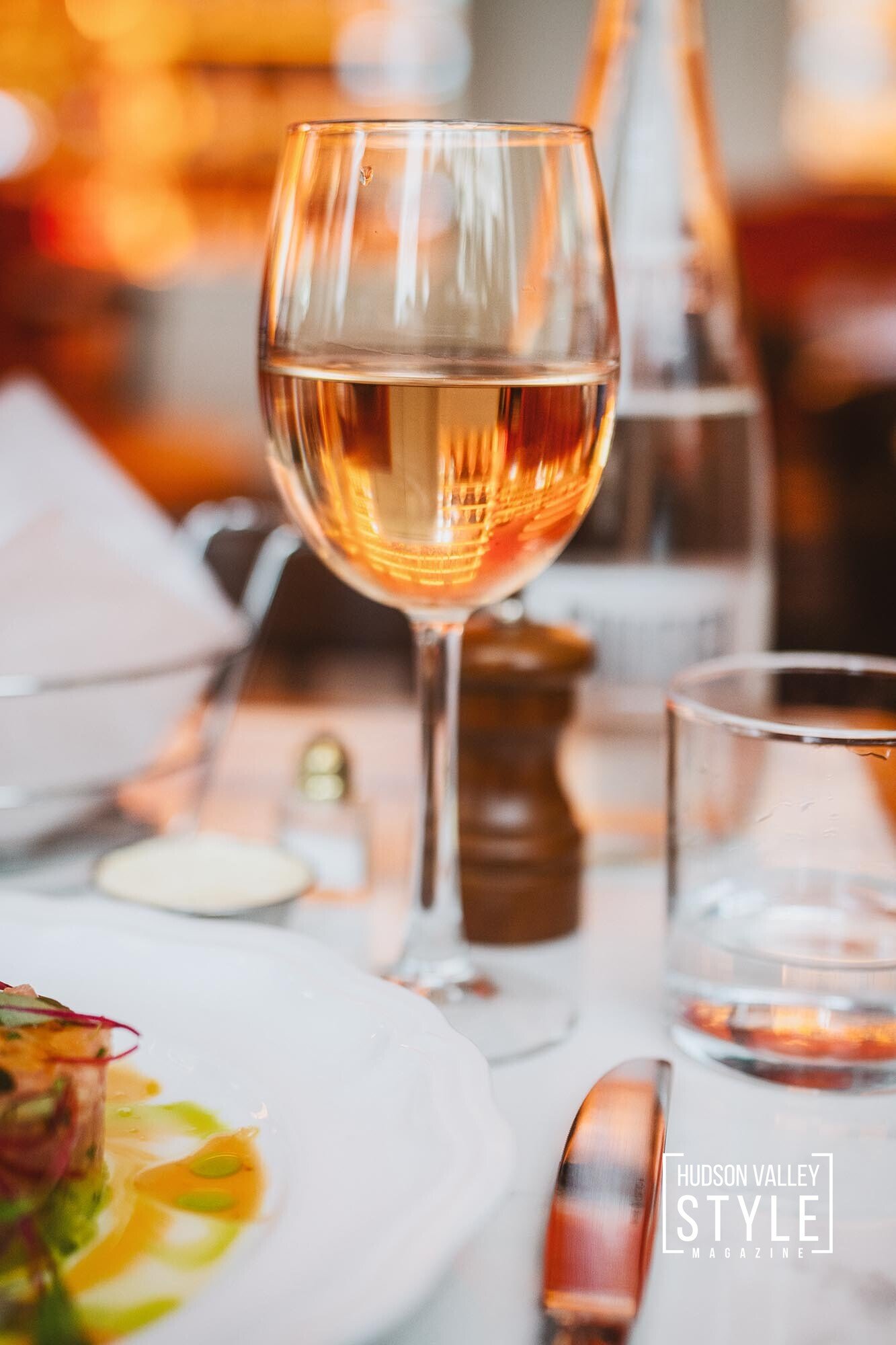
Fresh tuna rested over avocado and cucumber, finished with tomatoes and a sesame-ginger dressing. The interplay of color—pale pink fish, bright green avocado, deep red tomato—gave the dish a natural vibrancy that translated beautifully through the lens.

Toasted bread on the side added textural contrast to the composition, its craggy surface catching light in a way that gave the plate depth and dimension. In food photography, texture is often the hardest quality to translate from plate to frame — it’s not enough to capture color and shape; the camera has to register the crunch before the viewer ever picks up a fork. Toasted bread solves that problem instantly. Its uneven, blistered surface fractures light into dozens of tiny highlights and shadows, creating micro-contrast that a smooth surface simply can’t produce. That’s why toast, crusts, and seared edges show up so often as supporting elements in editorial food photography: they do the visual work of communicating texture that flavor alone can’t convey on a page.

Positioned beside the tartare, the toast also served a compositional function, giving the plate a secondary focal point and enough visual weight to balance the softer, glossier textures of the fish and dressing. It’s a small detail, but one that separates a technically accurate food photograph from one that actually makes a viewer feel the meal — the kind of craft Duncan Avenue Studios applies across its editorial photography and food/hospitality photography, where every plate is treated as its own small architecture of light and texture.

A glass of Whispering Angel Provence Rosé (2024) rounded out the frame—crisp, floral, and effortlessly photogenic, its pale pink hue echoing the tartare beside it. Together, the pairing became one of the afternoon’s most complete compositions, food and wine speaking the same visual language as the architecture around them.

Lighting Design and the Grand Chandeliers
Lighting design is the essential architecture of any great dining room, and Brasserie Cognac Américain treats it as a headline feature rather than an afterthought. The space builds its atmosphere through a layered lighting scheme—statement fixtures, warm color temperature, and dramatic focal points working together rather than any single source doing the heavy lifting. At the room’s center, a double-tiered wagon-wheel chandelier anchors the space as a true architectural lighting statement: two concentric rings studded with dozens of exposed bulbs against a blackened iron frame, part carriage lamp, part halo, suspended from a single chain against a wall of deep red and black lace-print paneling. The exposed-bulb design choice is a hospitality lighting signature in its own right, trading the softness of shaded fixtures for texture, dimension, and a warm, flickering glow that reads as both vintage and theatrical—the kind of focal lighting fixture designed to draw the eye upward and define the room’s character before a single plate hits the table.

Nearby, a brass fixture takes the opposite approach: clusters of matte white glass globes branching off slender antiqued arms, softer and more diffuse against the same saturated red backdrop. The pairing sets up a dialogue between two lighting vocabularies—exposed filament versus frosted glow—that plays out across the room.
Downstairs, the bar reframes the whole conversation. Floor-to-ceiling backlit shelving turns hundreds of bottles into a wall of amber light, the glow bouncing off marble countertops and warm leather seating until the entire space reads like it’s lit from within.
It’s this range—sculptural overhead fixtures upstairs, ambient shelf-lighting below—that gives the room its layered, cinematic quality from every angle. It’s a lighting hierarchy that reads as deliberate hospitality design strategy: statement fixtures establish visual drama and architectural focal points, while integrated shelf and cove lighting handles the quieter work of mood-setting and spatial warmth. Layered lighting design like this—mixing ambient, task, and accent sources—is the backbone of contemporary restaurant interior design, allowing a single room to shift character from daytime service to evening atmosphere without a single fixture changing. Combined with the brass detailing, marble surfaces, and rich material palette throughout, the lighting scheme functions less like an afterthought and more like the room’s connective tissue—tying bar, dining room, and staircase into one continuous hospitality experience, engineered as much for guest atmosphere as for photographic impact.
Chicken Paillard: Scale and Simplicity
The chicken paillard arrived generously portioned, a plate built on scale rather than ornamentation. Its accompanying salad—peppery arugula, roasted tomatoes, pine nuts, and champagne vinaigrette—brought texture and color that anchored the composition and gave the frame its visual center.

French Brasserie Design in the New York Restaurant Scene
New York’s restaurant scene has always rewarded spaces that understand their own theater. The Bryant Park dining district, in particular, has become a proving ground for rooms engineered around light, color, and architectural spectacle—and Brasserie Cognac Américain ranks among the most visually ambitious entries in that landscape.

The architecture is extraordinary. The lighting is cinematic. The glowing walls of wine deserve their own architectural recognition, and the music transports diners across the Atlantic before the first course arrives.

For photographers covering French cuisine, hospitality design, and the ever-evolving New York restaurant scene, rooms like this remain essential subjects—proof that a well-designed brasserie can carry as much narrative weight through the lens as it does on the plate.


Somewhere between the amber glow and the last glass of rosé, the city’s oldest culinary truth reasserts itself: French design travels, French light photographs, and Midtown remains one of the great stages for both.